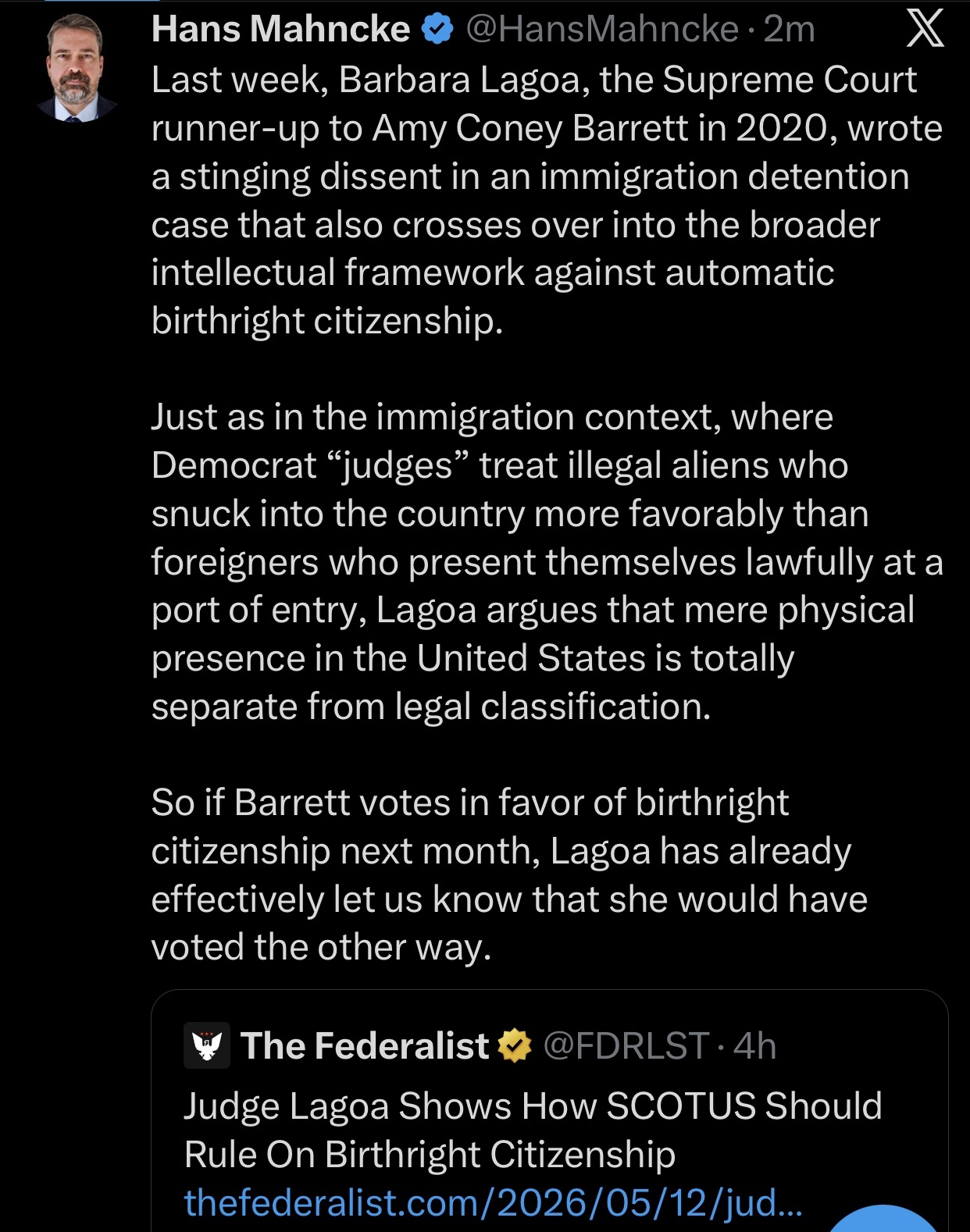
@RobertBarnes @VivaFrei and all. 🚨IMPORTANT! Robert, remember how you, me and many others on VBL and others supported Judge Barbara Lagoa as Trump’s SCOTUS nominee based on her rulings etc? Well, Hans Mahncke has written for the Federalist about a Judge Lagoa’s dissent provides a roadmap “How SCOTUS Should Rule on Birthright Citizenship.” TAP for full image.
https://x.com/fdrlst/status/2054199922833187098
“President Trump issued a sharply worded Truth Social rebuke of Justices Neil Gorsuch and Amy Coney Barrett, criticizing their recent tariff ruling and warning against what he described as a “negative ruling on Birthright Citizenship” in a highly anticipated decision expected next month. Trump appointed Barrett to the Supreme Court in 2020, following the vacancy left by the death of Ruth Bader Ginsburg, over appeals court Judge Barbara Lagoa of the 11th Circuit in Atlanta.
Perhaps not coincidentally, Lagoa just last week authored a dissent in a case addressing whether illegal aliens who slip into the country undetected should benefit from more favorable legal treatment than those who present themselves lawfully at the border. The opinion has drawn attention in legal circles and reads as a clear expression of a textual judicial philosophy that extends beyond immigration into related questions, including birthplace citizenship.
Lagoa’s opinion stands out for its tightly textual and structurally disciplined approach, which is resistant to softening statutory language or reshaping enacted law based on inferred legislative intent. It also naturally raises a broader “what if” question about how the Supreme Court’s recent trajectory might have evolved had Lagoa been appointed in 2020 instead of Barrett.
The Paradox in Immigration Detention
The case, Alvarez v. Warden, is part of a series of immigration cases now working their way through the circuits after the Trump administration in 2025 reversed decades of policy drift. For years, the legal framework governing immigration detention produced a result that is difficult to explain in common-sense terms. Individuals who present themselves at a port of entry and are not admitted are placed in mandatory detention, while those who cross the border illegally and are later apprehended inside the country are eligible for bond hearings and release back into the community. In other words, compliance with the legal process results in stricter conditions than evasion of that process. It is this paradox that sits at the heart of the current dispute over the Immigration and Nationality Act.
The statute turns on two phrases: “applicant for admission” and “seeking admission.” The Fifth and Eighth Circuits have held that they are effectively synonymous in this context, meaning that illegal entrants apprehended inside the United States remain subject to mandatory detention under § 1225(b)(2)(A). The Second and 11th Circuits have taken the opposite view, distinguishing between legal status and geographic status. They say that those who entered the country illegally are not “seeking admission” and therefore fall under a different section, § 1226(a), which permits release.
Lagoa rejects that distinction from the outset. Her starting point is the statutory text, particularly Congress’s decision to deem unadmitted aliens physically present in the United States as “applicants for admission.” The force of her approach is clearest in her treatment of the majority’s reasoning. As she notes, “The majority concedes that ‘applicant for admission’ and ‘seeking admission,’ on their ordinary meaning, are ‘synonymous.’ It then spends fifty pages explaining why the ordinary meaning does not apply.” When Congress defines a category, courts are not free to recast it through interpretive layering. Statutory interpretation, in her view, begins and ends with the text Congress enacted.
Text Over Legislative Intent
From that premise, she builds a broader interpretive framework grounded in formal legal meaning rather than policy intuition or administrative practice. Her dissent is notably unsympathetic to legislative history as an interpretive aid.
At one point, she invokes Justice Scalia’s familiar critique of legislative history, describing the exercise as akin to “entering a crowded cocktail party and looking over the heads of the guests for one’s friends.” The point is not stylistic flourish but the deeper institutional concern that attempts to reconstruct legislative intent are inherently selective, often outcome-driven, and tend to introduce more ambiguity and obfuscation into statutory interpretation than they resolve. Elsewhere, she echoes Scalia’s even sharper formulation that “[W]e are governed by laws, not by the intentions of legislators,” underscoring her view that statutory meaning must be derived from enacted text rather than inferred purpose.
That methodological commitment carries through into her treatment of immigration precedent. She situates the Immigration and Nationality Act within a line of cases rejecting the idea that physical presence alone determines legal classification.
She anchors her dissent in earlier Supreme Court decisions, reaching back to Kaplan v. Tod (1925). In that case, the Supreme Court held that a child physically present in the United States for years while excluded at Ellis Island had not legally “dwelt” in the country at all. As the court put it, she was still “in theory of law at the boundary line and had gained no foothold in the United States,” even after years of physical presence. By invoking this specific line of reasoning, Lagoa reinforces the principle that immigration status is a product of legal designation, not mere geography.
She then traces that logic forward to Leng May Ma v. Barber (1958), where the Supreme Court held that a parolee physically present in the United States could not rely on statutory protections reserved for those “within the United States.” This is because parole keeps the individual in a separate legal status, as if they had never fully entered the country. Her emphasis here is that even “undisputed physical presence” cannot override the legal classification Congress created.
In highlighting this boundary line, Lagoa leaves a significant Easter egg regarding her view on birthplace citizenship. By asserting that physical presence does not equate to legal presence, she signals a reading of the 14th Amendment in which so-called birthright citizenship is not automatic.
Taken together, these cases support Lagoa’s central proposition that when Congress defines a legal status that differs from everyday reality, courts are bound to apply that definition consistently, even when it does not match the underlying physical situation.
It is this formalism that drives her rejection of the majority’s effort to separate “applicant for admission” from “seeking admission.” In her view, once Congress has classified an unadmitted alien as an applicant for admission, the statute does not permit courts to reintroduce a second, unwritten condition based on physical location or perceived activity. To do so would be to rewrite the statute under the guise of interpretation.
The broader consequence of the competing interpretations is now reflected in a deepening circuit split. Under the broader reading adopted by the Fifth and Eighth Circuits, illegal entrants remain subject to mandatory detention until they are admitted or removed. Under the narrower reading adopted by the Second and 11th Circuits, many such individuals become eligible for bond hearings once inside the country, despite never having been lawfully admitted.
The practical divergence is substantial, but the underlying dispute is more fundamental still. It concerns whether immigration detention law is governed by the plain consequences of statutory classification, or by a more flexible reading that adjusts legal categories to align with perceived legislative purpose or how the executive branch chooses to enforce the law.
Barrett vs. Lagoa
Lagoa’s dissent leaves little doubt as to where she stands. Courts are not authorized to soften statutory schemes they find unwise nor to recalibrate legal classifications in light of policy discomfort. Their role is to apply the statute as written, including the legal categories Congress deliberately defines.
In that sense, the dissent also reads as more than a contribution to an ongoing circuit dispute. It is a window into a judicial philosophy that is formal, restrained, and unapologetically text-centered. It also inevitably invites comparison to the Supreme Court that might have been. Justice Barrett’s tenure has already included a number of closely divided and ideologically mixed cases that reflect the court’s current direction.
In Fischer v. United States (2024), Barrett wrote a forceful dissent, joined by Justices Sotomayor and Kagan, disagreeing with the majority’s narrower reading of a federal obstruction statute used in Jan. 6 prosecutions. And in Trump v. J.G.G. (2025), involving the use of the Alien Enemies Act to support deportations of Venezuelan gang members, she again joined the court’s liberal justices in questioning the government’s reliance on that statute for deportations.
There is also the upcoming decision in Trump v. Barbara, the birthplace citizenship case, where Barrett’s position remains uncertain and may prove decisive. In contrast, Lagoa’s reasoning in Alvarez v. Warden strongly signals an approach under which automatic citizenship does not follow from presence alone.
Lagoa’s approach raises a compelling question: How might recent Supreme Court decisions have been resolved had she been appointed in 2020? What is certain is that, with the circuit courts now mired in intractable conflict, a Supreme Court resolution of the immigration detention issue is inevitable. Barrett’s eventual vote will offer a direct comparison with the judicial philosophy Lagoa has already put on the record.
But the more immediate test will come next month, when the Supreme Court rules on birthplace citizenship. Lagoa’s dissent strongly signals where she stands. The question is what Barrett will do.”