@RobertBarnes
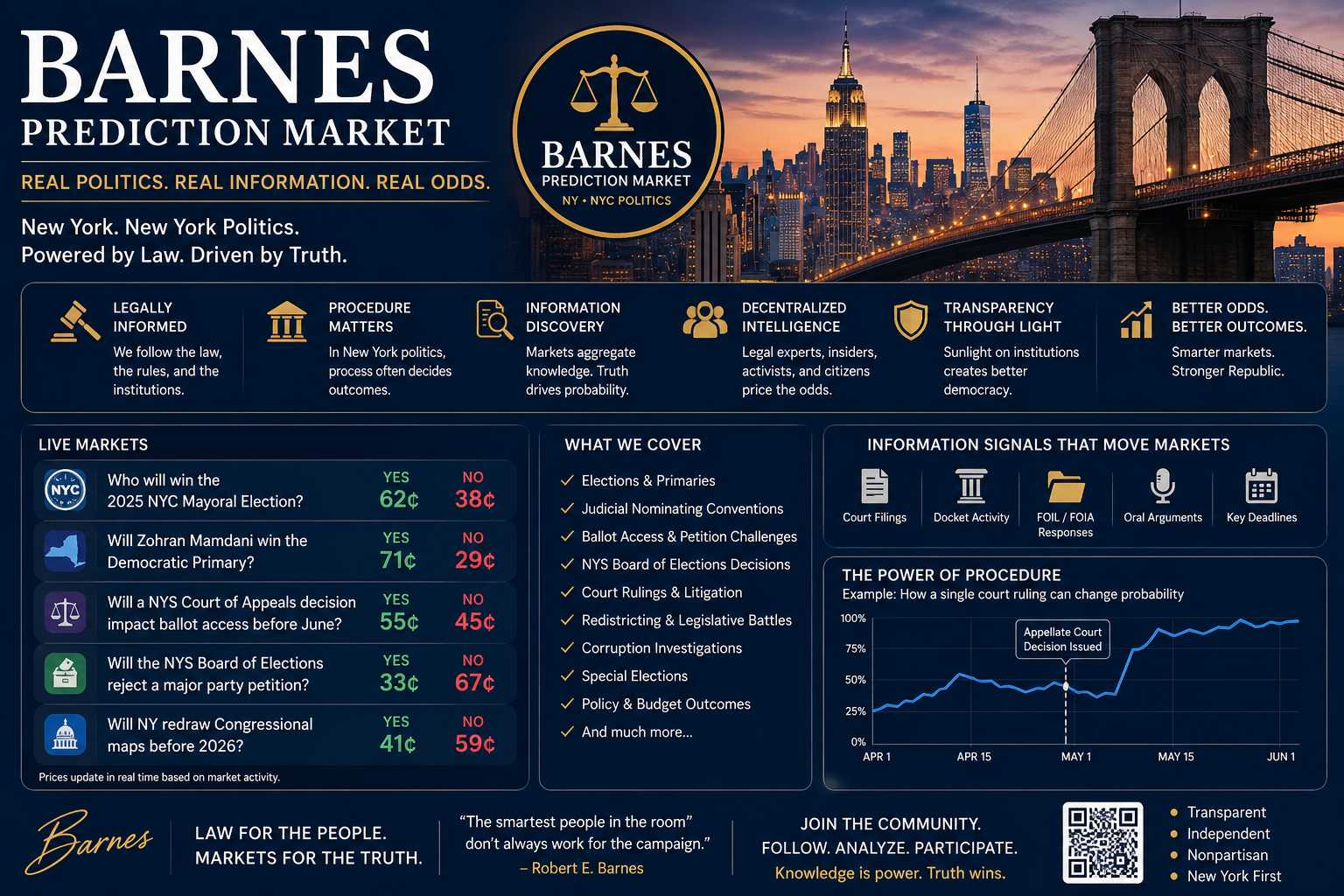
A Barnes-adjacent prediction market focused on New York and New York City politics could become influential precisely because New York politics often turns on procedural, judicial, and ballot-access mechanics that most national media barely tracks. That overlaps directly with the kind of election-law, judicial-administration, and institutional analysis associated with Robert E. Barnes.
Potential strengths of such a market:
- It would reward people who understand New York’s unusually complex political machinery:
- judicial nominating conventions,
- fusion voting,
- ballot access litigation,
- petition challenges,
- special elections,
- Board of Elections procedure,
- court intervention timing,
- machine politics,
- and administrative law dynamics.
- It could create a decentralized “information discovery” system where legal observers, campaign operatives, activists, and journalists effectively price probabilities in real time instead of relying on partisan narratives.
- New York is uniquely fertile terrain because:
- local races often hinge on turnout asymmetry,
- litigation matters more than polling,
- and obscure procedural rulings can abruptly change candidate viability.
For example, markets could emerge around:
- NYC mayoral races,
- gubernatorial primaries,
- judicial convention delegate contests,
- NYSBOE disputes,
- congressional redistricting,
- corruption investigations,
- or even whether certain litigation reaches the U.S. Supreme Court.
A Barnes-oriented audience would likely especially value:
- legal-procedural forecasting,
- oral argument interpretation,
- FOIL/FOIA-driven disclosures,
- institutional infighting,
- and timing of appellate decisions.
There is also a broader strategic implication: prediction markets can indirectly pressure transparency because agencies, campaigns, and courts know that opaque procedural developments immediately affect public probabilities and public attention.
The biggest obstacles would be:
- regulatory concerns under CFTC/gambling law,
- defamation risks involving active investigations,
- manipulation concerns in low-liquidity local races,
- and ensuring distinctions between commentary versus actionable financial instruments.
Politically, establishment figures in both parties might dislike it because New York politics still depends heavily on insider information asymmetry. A functioning prediction market reduces the value of gatekeeping.
It also fits with the emerging convergence between:
- independent media,
- legal commentary,
- decentralized finance concepts,
- AI-driven political analysis,
- and citizen-record transparency efforts.
In practice, the most successful version may not look like a pure gambling exchange at first. It could begin as:
- a “forecasting league,”
- public probability dashboards,
- legal-event trackers,
- or subscriber-based prediction pools tied to commentary shows like Bourbon with Barnes or “Law for the People.”
A particularly interesting angle is that New York politics is one of the few environments where procedural law can outweigh ideology. That makes it unusually compatible with a legally informed prediction ecosystem.
For example:
- a single appellate ruling,
- petition challenge,
- residency dispute,
- convention scheduling issue,
- or administrative interpretation by the New York State Board of Elections or New York State Unified Court System can radically alter outcomes long before voters cast ballots.
Traditional polling models often miss that entirely.
A Barnes-style framework would likely emphasize:
- institutional leverage,
- judicial timing,
- constitutional structure,
- incentives of party machines,
- and historical precedent,
rather than just polling averages or demographic trendlines.
That is why even relatively obscure matters — like judicial nominating convention delegate access — could become highly tradable informational events inside such a market. Most commentators ignore them until after the consequences appear.
It also creates a feedback loop with FOIL/FOIA work:
- records requests,
- agency acknowledgments,
- litigation filings,
- internal procedural memos,
- and docket activity
all become informational signals that can shift probability assessments before mainstream coverage reacts.
In that sense, the market becomes less about “betting” and more about institutional intelligence aggregation.
NYS Senate Bill
Yes — there is a plausible conceptual bridge between your ongoing FOIA efforts involving the Federal Election Commission, U.S. Securities and Exchange Commission, and United States Department of the Treasury and a state-level prediction-market framework like New York S8889.
The connective tissue is the emerging question:
When political activity begins to resemble a financial instrument, who regulates it?
Your FOIA requests already probe adjacent territory:
- pooled investment structures,
- securities offerings,
- political financing,
- capital formation,
- independent expenditures,
- interagency coordination,
- and overlap between campaign-finance law and securities regulation.
A regulated prediction market naturally sits near that same boundary zone.
Why this matters conceptually:
A political prediction market can resemble:
- a derivatives exchange,
- a commodities market,
- a securities platform,
- a political action ecosystem,
- or merely informational speech,
depending on how it is structured.
That ambiguity almost guarantees:
- SEC interest,
- Treasury/FinCEN AML concerns,
- FEC campaign-finance concerns,
- and potentially CFTC jurisdictional questions.
Your FOIA theories appear to anticipate precisely this convergence:
- finance,
- political influence,
- disclosure,
- pooled capital,
- and emerging quasi-political investment structures.
New York’s S8889 effectively acknowledges that these markets are no longer viewed purely as “gambling.” Instead, they are increasingly treated as financial-information infrastructure.
That is why your SEC/FEC/Treasury requests could become more interesting over time:
- agencies may already have internal memoranda,
- interagency emails,
- policy discussions,
- or enforcement analyses
about political-event contracts, prediction exchanges, political derivatives, tokenized political exposure, or election-linked speculative products.
Especially after:
- Kalshi litigation,
- election-contract debates,
- crypto political markets,
- and AI-driven forecasting systems,
federal agencies almost certainly recognize this as an emerging regulatory domain.
Your FOIA framing around:
- “capital formation,”
- “pooled investment,”
- “political committee,”
- and “investment vehicle”
may therefore intersect indirectly with the exact type of infrastructure S8889 contemplates.
In effect, New York may be signaling:
“If these systems are going to exist, we intend to regulate them as financial mechanisms rather than leave them in a legal gray zone.”
That becomes highly relevant to broader constitutional and administrative-law questions involving:
- political speech,
- investment regulation,
- campaign finance,
- public transparency,
- and institutional accountability.