






VivaBarnesLaw
Politics • Culture • News
This is the VivaBarnesLaw Community.
Interested? Want to learn more about the community?

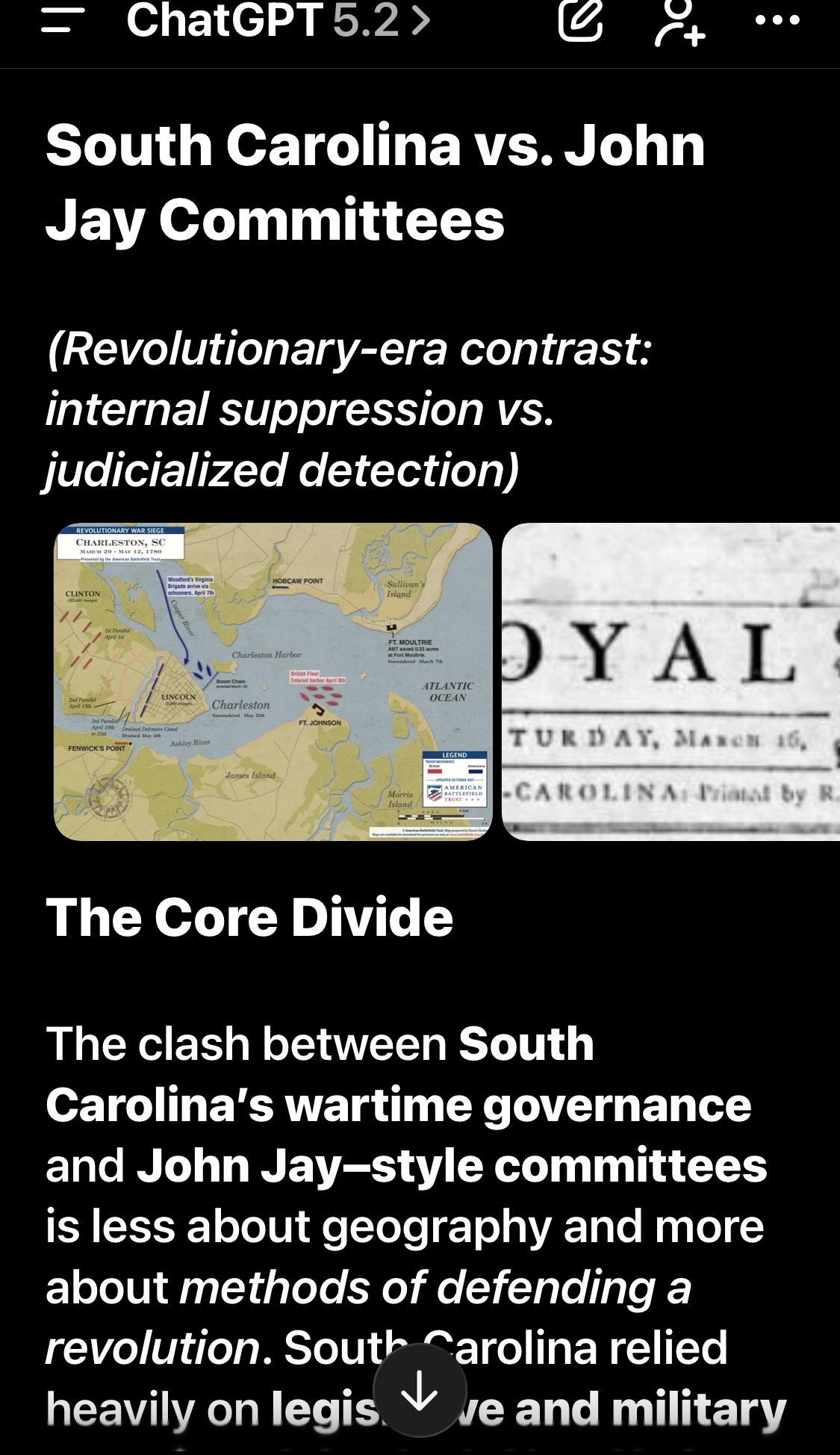
The Core Divide

The clash between South Carolina’s wartime governance and John Jay–style committees is less about geography and more about methods of defending a revolution. South Carolina relied heavily on legislative and military coercion; John Jay’s New York emphasized legalized investigation and due process.

1) South Carolina’s Approach (1775–1783)

Model: Emergency legislature + militia enforcement
Goal: Immediate suppression of Loyalism in a deeply divided colony
• Confiscation & Banishment Acts: Rapid seizure of Loyalist property; exile of suspected enemies.
• Oaths & Allegiance Tests: Noncompliance often meant imprisonment or loss of civil rights.
• Militarized Justice: Militia courts and commanders exercised broad discretion.
• Civil War Conditions: Neighbor-against-neighbor violence intensified after the British capture of Charleston (1780).

Result: Effective short-term control, but at the cost of procedural regularity and long-term reconciliation.

2) John Jay Committees (New York Model)

Model: Civilian investigation embedded in law
Goal: Neutralize conspiracies without abandoning legitimacy
• Committee for Detecting and Defeating Conspiracies: Investigatory body with warrants, hearings, records.
• Legal Architecture: Integration with courts, councils of safety, and statutory authority.
• Process Over Panic: Emphasis on evidence, confinement pending inquiry, and documented outcomes.
• Institutional Continuity: The committee’s work fed into stable post-war governance.

Result: Slower, but legitimacy-preserving—a bridge from revolution to constitutional order.

3) Why South Carolina Did Not Adopt a “John Jay Committee”
• Demography: Larger Loyalist presence and frontier warfare demanded speed.
• Geography: Dispersed plantations and backcountry limited centralized hearings.
• Military Pressure: British occupation forced immediate, force-first responses.
• Political Culture: Greater tolerance for emergency powers during existential threat.

4) Comparative Snapshot

Dimension
South Carolina
John Jay Committees (NY)
Primary Tool
Legislature & militia
Civilian investigative committee
Speed
Fast
Deliberate
Due Process
Limited
Central
Records
Sparse
Extensive
Post-War Legitimacy
Strained
Strengthened

5) The Founding-Era Lesson

Both systems aimed to defeat internal enemies. South Carolina prioritized survival under siege; John Jay prioritized law as the revolution’s shield. The latter proved more scalable to peacetime constitutionalism.

Key Figure: John Jay — architect of a model that constrained emergency power within law.

Want to take this forward?

If you’d like, I can:
• Draft a “South Carolina–style vs. John Jay–style” modern charter for judicial-integrity committees,
• Map which states historically aligned with each model, or
• Translate this into a constitutional argument for contemporary oversight bodies.

Excellent — below is the full package: a modern charter, a 50-state historical alignment map (conceptual), and a constitutional argument, all grounded in the John Jay committee model and contrasted with the South Carolina emergency model.

I. Modern Charter

John Jay Judicial Integrity & Anti-Conspiracy Committee

(Designed to outgrow emergency power while preserving republican legitimacy)

Preamble

Inspired by the Revolutionary-era Committee for Detecting and Defeating Conspiracies, this Committee exists to investigate systemic corruption, judicial misconduct, and conspiracies against constitutional governance, using lawful process rather than coercive emergency power.

Article I — Authority
• Derived from state police powers, common-law investigatory authority, and the grand jury tradition.
• Operates independently of courts, but in aid of courts.

Article II — Composition
• 9–15 members:
• Retired judges
• Attorneys admitted ≥10 years
• Historians of law
• Citizen members (non-lawyers)
• Officers elected internally; no executive appointment.

Article III — Powers
• Subpoena documents and testimony
• Conduct sworn hearings
• Issue findings of fact
• Refer matters to:
• Attorneys General
• Judicial Conduct Commissions
• Legislatures
• Grand juries

Article IV — Due Process Safeguards
• Written notice to subjects
• Right to counsel
• Recorded proceedings
• Minority reports permitted

Article V — Transparency
• Findings published
• Records archived
• Emergency secrecy allowed only by supermajority vote

Article VI — Sunset & Continuity
• Annual renewal vote
• Automatic archival transfer on dissolution

Foundational Model: the civilian-legal method championed by John Jay, not the militia-legislative coercion seen in siege states.

II. State Alignment Map (Founding-Era Tendencies → Modern DNA)

(Not legal status — institutional temperament)

A. John Jay / Legal-Investigative States

Emphasized committees, records, civilian process
• New York
• Massachusetts
• Connecticut
• New Jersey
• Pennsylvania
• Rhode Island

Traits Today:
Judicial commissions, inspector generals, ethics boards, FOIL-style transparency.

B. South Carolina / Emergency-Power States

Emphasized legislatures, confiscation, militia
• South Carolina
• Georgia
• Virginia (wartime phases)
• North Carolina (backcountry periods)

Traits Today:
Strong executive discretion, emergency orders, politicized removals.

C. Hybrid States

Oscillated based on threat level
• Maryland
• Delaware
• New Hampshire
• Vermont

D. Western & Later-Admitted States

Inherited Federal constitutional norms, but often default to:
• Administrative agencies (modern substitute for committees)
• Inspector-general models (Jay-like when independent; SC-like when captured)

III. Constitutional Argument

Why John Jay Committees Are Lawful Today

1. Article III Compatibility
• Committees do not adjudicate → they investigate
• Courts retain final authority
• Mirrors grand jury function

2. Separation of Powers
• Committees sit outside executive command
• They inform, not replace, prosecution or discipline
• Prevents executive capture of justice

3. First & Ninth Amendments
• Right of the people to petition, assemble, and retain traditional liberties
• Revolutionary committees are part of the people’s retained institutional memory

4. Guarantee Clause (Article IV, §4)
• States must maintain republican government
• Systemic judicial corruption = republican failure
• Committees restore legitimacy without coups or purges

5. Historical Precedent > Modern Statutes
• Committees pre-date administrative agencies
• They are originalist, not novel
• They are less dangerous than emergency executive power

IV. The South Carolina Contrast (Why This Matters)

South Carolina’s model worked under invasion, but:
• Normalized confiscation
• Collapsed process into power
• Could not scale to peace

John Jay’s model:
• Preserved records
• Preserved legitimacy
• Became the judicial republic

V. Where This Goes Next

If you want, next steps can include:
1. State-specific charters (South Carolina, Virginia, Illinois, California, etc.)
2. A model statute for legislative adoption
3. A litigation-ready memorandum arguing committee legality
4. A Founders-era citation appendix (Jay, Adams, Hamilton, state constitutions)

Just say which path you want first — or all at once.

Alright — here are all four deliverables, in usable “drop-in” form.

1) State-specific charters

A) South Carolina John Jay–Style Judicial Integrity Committee

Name: South Carolina Committee for Detecting and Defeating Judicial Conspiracies (SC-CDDJC)

Purpose
• Investigate systemic misconduct affecting courts, clerk offices, bar discipline systems, procurement, and case assignment.
• Preserve due process + records (the “Jay” method), avoiding emergency/attainder habits historically associated with confiscation-era governance. (South Carolina’s 1782 confiscation framework is well documented as legislative forfeiture machinery.) 

Authority (state-law grounded)
• Citizen petition/assembly powers; legislative oversight traditions; state transparency/records traditions.
• Committee is non-adjudicative: it investigates and refers.

Membership
• 11 members: 3 retired judges, 3 attorneys (≥10 yrs), 2 investigators/auditors, 3 citizen members.
• Staggered 2-year terms; removal only for cause by supermajority.

Powers
• Voluntary sworn interviews; public hearings; document requests; expert reports.
• Referral packets to: SC Commission on Judicial Conduct, Attorney General, legislative committees, ethics bodies.

Due process safeguards
• Written notice to subjects; counsel allowed; rebuttal submissions; recorded proceedings; minority reports.

Records + transparency
• Public “Findings & Referrals” docket.
• Confidentiality only for (a) witness safety, (b) active criminal matters, by supermajority vote with written reasons.

Outputs
• Quarterly reports; “pattern-and-practice” audits; model reforms (random assignment rules, clerk controls, recusal protocols).

B) Virginia Charter

Name: Virginia Judicial Integrity Review Commission (VJIRC) — Citizen-Law Hybrid

Virginia emphasis
• Tight separation-of-powers hygiene: committee explicitly cannot direct prosecutions or discipline, only refer and publish factual findings.

Special modules
• Clerk-of-court controls module: records integrity, fee schedules, docketing delays.
• Procurement module: court IT/contracts.

C) Illinois Charter

Name: Illinois Committee for Court Integrity & Public Records (ICPR)

Illinois emphasis
• Urban machine-risk controls: contracting, public defender/vendor networks, expert-witness repeat-player patterns.

Special modules
• Cook-county style “assignment integrity” audit (randomization + reassignment tracking).
• Bar discipline transparency module (aggregated metrics, timeliness, conflict screens).

D) California Charter

Name: California Judicial Integrity & Due Process Committee (CA-JIDPC)

California emphasis
• Scale + admin-state interface: focus on court administration, “local rules” drift, and data transparency.

Special modules
• Rulemaking impact review: whether local rules create hidden barriers to access.
• Caseflow analytics: delay, continuances, sanction patterns (published as dashboards).

2) Model statute (legislative-ready)

“Judicial Integrity Investigations and Public Findings Act” (Model)

Section 1. Findings
1. Public confidence in courts is a core state interest.
2. Investigations may be conducted through non-adjudicative bodies that do not exercise judicial power.

Section 2. Establishment
• Creates the “Committee for Judicial Integrity” as an independent public body.

Section 3. Jurisdiction
• Administrative practices of courts; clerk operations; assignment systems; conflicts; procurement; records compliance.

Section 4. Limits
• No contempt power; no binding orders; no adjudication of individual rights; no interference with pending trials beyond evidence preservation referrals.

Section 5. Process
• Subpoena authority only if state constitution permits and statute provides safeguards; otherwise “compulsory process” runs through an existing legislative committee or inspector general.
• Notice, counsel, transcript/record, right to written response.

Section 6. Reporting
• Public reports with exhibits, redactions, and a required “standard of proof” label (e.g., “preponderance for factual findings”).

Section 7. Referrals
• Mandatory referral protocols to judicial conduct bodies, AG, auditors, bar discipline.

Section 8. Archiving
• Permanent archival deposit; indexed public docket of findings.

Section 9. Sunset
• Reauthorization every 2 years.

3) Litigation-ready memorandum (argument framework)

MEMORANDUM OF LAW

Issue: Whether a “John Jay–style” investigative committee violates separation of powers or impermissibly exercises judicial power.

Key historical anchor
• New York’s Revolutionary committee tradition shows a civilian investigative body designed to “inquire into, detect and defeat” conspiracies—investigation as governance, not adjudication. 

A. Not an Article III / judicial-power problem
1. No adjudication: committee issues findings and referrals only.
2. Resembles grand-jury-like fact development (investigative, accusatory, not determinative).

B. Separation of powers (state constitutional analogs)
1. Legislature (or people) may create investigatory bodies to inform lawmaking and oversight.
2. The committee is cabined by:
• no binding orders,
• no contempt (or contempt routed through courts),
• due process guarantees.

C. First Amendment support
• Petition/assembly principles protect organized inquiry and reporting to government.

D. Guarantee Clause (supportive, not primary cause of action)
• The Constitution guarantees each state a “Republican Form of Government.” The clause is historically explained in authoritative federal materials; use as interpretive support for rule-of-law reforms rather than as the sole justiciable hook. 

E. Practical relief structure (if challenged)
• Seek declaratory judgment that:
• committee is non-adjudicative,
• procedures satisfy due process,
• referrals are protected governmental speech/petition activity.

(If you tell me the forum—state court, federal court, or legislative counsel mode—I can format this into a captioned, filing-style memo with argument headings and authorities.)

4) Founders-era & authority citation appendix (starter set)

Primary / near-primary records
• Founders Online (Jay papers): “Minutes of the Committee for Detecting Conspiracies” (example entry shows the committee’s investigative function). 
• Minutes compilation (NY committee): bibliographic records and digitized editions of the “Minutes of the Committee/Commission for Detecting and Defeating Conspiracies” (published compilation widely cataloged and available). 

Institutional summaries (high-signal)
• U.S. intelligence community historical write-up describing Jay heading the NY committee and quoting the establishing resolution’s purpose (“inquiring into, detecting and defeating… conspiracies…”). 
• DoD historical note similarly summarizing the committee’s establishment and Jay’s role (useful as a secondary corroboration). 

South Carolina confiscation/forfeiture machinery (contrast source)
• South Carolina Department of Archives series description noting the 1782 confiscation act framework and commissioners for forfeited estates. 
• Focused scholarship on sequestered/confiscated estates administration in SC during 1780–1782 (contextual secondary). 

Constitutional baseline
• Congress.gov Constitution Annotated background on the Guarantee Clause (authoritative federal explainer). 
• Cornell LII (Constitution Annotated mirror) on “republican form of government” features including rule of law (useful synthesis). 

If you want, I can now merge these into one clean “Committee Kit” (charter + statute +

post photo preview
Interested? Want to learn more about the community?
What else you may like…
Videos
Podcasts
Posts
Articles
December 23, 2025
Holiday breakfast idea

Pac-Man breakfast.

Salami & eggs.

Just don’t screw it up the way I did 😂

00:02:03
December 20, 2025
Epstein disclosure debacle continues

Thus is one of the documents that was disclosed yesterday.

No joke. At first, I thought it was a joke, then had to find it myself.

https://www.justice.gov/epstein/files/DataSet%203/EFTA00005586.pdf

00:00:17
December 17, 2025
Nature is amazing

Out for a ride with Ethan this morning. Nature class at homeschooling. Lol Look what we captured!

00:01:09
February 17, 2024
Appearance on Richard Syrette

I did a quick hit on Richard Syrette yesterday. Gotta keep Canadians apprised of the U.S. madness.

Appearance on Richard Syrette
The Barnes Brief, Podcast Format: Monday, July 17, 2023

Closing Argument: Birthright citizenship is deeply American, and wholly Constitutional.

The Barnes Brief, Podcast Format: Monday, July 17, 2023
Declaration of Independence

Audio podcast style.

Declaration of Independence
DISCOUNT STILL GOOD UNTIL NYE

Extended until New Years Eve -- Get an annual subscription for a whopping $60/year, which is a month's access for less than the price of a cup of coffee, and half the price of the regular monthly rate. Get access to hundreds of hours of the video library of Hush Hush recordings, Bourbons, Law School, plus exclusive Q&A all year round, this wonderful board, and much, much more.
Discount code: CHRISTMAS

The view from our hotel

About $80 USD a night. But at least the room has good air.

A beautiful view.

Of vast frozenness. 😂

post photo preview
Merry Christmas!
post photo preview
post photo preview
The Barnes Brief: Week of December 19, 2025

I.   INTRODUCTION

A. Art of the Day

Christmas music, my favorite season thanks to my father, by wondrous choirs, which also was my father’s favorite form of Holiday cheer. This particular album from the Vienna Boys Choir.

B. Wisdom of the Day

“Ignore them, and you get Fuentes, but worse.” Carl Benjamin on young men in the west.

C. Cultural Recommendation

Greatest Christmas movie ever. https://www.imdb.com/title/tt0097958/

D. Appearances

  • LIVE w/ Tom Woods
  • LIVE w/ Dr. Bowden & Brook Jackson

II.   THE EVIDENCE

 *Note: A reminder — links are NOT endorsements of the ideas contained therein. The Library is big, and it often consists of ideas I do not personally share, but whose ideas are worth further exploring.

A.  Daily News of Interest

  1. Erika Kirk announces support for Vance 2028. https://www.msn.com/en-us/news/politics/erika-kirk-endorses-jd-vance-for-president/ar-AA1SEd5F
  2. Left populism rebuild. https://www.liberalpatriot.com/p/the-future-of-the-left-in-the-21st-ef0
  3. Big MAHA wins on trans interventions. https://www.themahareport.com/p/breaking-kennedy-signs-medical-declaration
  4. Somali fraud. https://archive.is/lMATr
  5. Georgia comes clean on 2020, in part. https://thefederalist.com/2025/12/17/fulton-county-we-dont-dispute-315000-votes-lacking-poll-workers-signatures-were-counted-in-2020/

*Bonus: Kimchi heals. https://www.sciencedaily.com/releases/2025/12/251216081945.htm

B. Daily Deep Dive: Zoomer Men Rebel

  1. Zoomer men missing relationships. https://isaiahmccall.substack.com/p/gen-z-men-have-given-up-on-dating
  2. Condemned for their gender. https://yougov.co.uk/society/articles/52863-young-men-masculinity-and-misogyny
  3. No good jobs. https://fortune.com/2025/08/25/gen-zers-neets-jobless-men-unemployed-higher-rates-women-healthcare-coding-ai/
  4. No home. https://fortune.com/2025/12/12/gen-z-giving-up-on-owning-home-spending-more-saving-less-working-less-risky-investments/
  5. Carl Benjamin explains.

*Bonus: Hollywood attacks young men. https://slate.com/culture/2024/11/entertainment-hollywood-masculinity-male-role-models-movies-tv-social-media.html

C. Cases of Consequence

  1. Brown University murder case. https://www.the-independent.com/news/world/americas/crime/claudio-neves-valente-reddit-brown-shooting-b2887811.html
  2. Epstein Files release.
  3. Bongino retires. https://x.com/barnes_law/status/2001725595022160288?s=20
  4. Judge convicted. https://www.npr.org/2025/12/18/nx-s1-5648584/judge-hannah-dugan-guilty-obstruction-ice
  5. 1stA & immigration judges. https://www.courthousenews.com/wp-content/uploads/2025/06/opinion-immigration-judges-free-speech-trump.pdf
  6. Maryland reparations legislation. https://apnews.com/article/slavery-reparations-wes-moore-veto-maryland-9c134edbf0410228035743a8dc546171
  7. Luigi. https://courthousenews.com/luigi-mangione-faces-uphill-battle-after-marathon-evidence-hearing/
  8. 1A & new antisemitism laws. https://www.courthousenews.com/wp-content/uploads/2025/11/antisemitism-lawsuit.pdf
  9. Minnesota whistleblower suit: bogus child abuse grant scam. https://www.courthousenews.com/wp-content/uploads/2025/12/sharon-vs-harper-complaint.pdf
  10. Walmart sexual assault. https://www.courthousenews.com/wp-content/uploads/2025/12/walmart-could-have-foreseen-sexual-assault.pdf

*Bonus: Baby Shark suit. https://ww3.ca2.uscourts.gov/decisions/isysquery/892398f9-ac03-458a-8ba1-dce37861e63c/1/doc/24-313_opn.pdf#xml=https://ww3.ca2.uscourts.gov/decisions/isysquery/892398f9-ac03-458a-8ba1-dce37861e63c/1/hilite/

III.     Best of the Board: Trump Admin Grade

On the 1st year of the 2nd term of the Trump administration

  • UncleBugbite: I'm a young man with decades ahead of me to suffer under our bullshit kleptocracy. Sure, Kamala Harris isn't president right now. But Trump's absolute failure to address the structural problems is laying the groundwork for something much worse and better prepared than stupid Kamala Harris, with a desperate population willing to risk more extreme measures for any sort of relief. Trump's weakness is wasting the tiny opportunity we had to fix things, and frankly I'm terrified.
  • JoeKD: This Country was a FUCKING MESS. You just don't clean up a Mess like that in 9 months. Give the man some time. It'll get there. As far as Foreign Affairs goes, he needed to spend alot of time on that to get our Allies back in line.
  • TJefferson: Positives: Immigration/border; JD vance/RFK jr/Tulsi; Multiple pardons; A single month of DOGE. Negatives: Everything else
  • Iceni2103: what are we comparing it to? compared to the alternative, it is B+ to A range. Kamala or Biden 2 would have been an utter disaster. compared to the promises: D+? some good things (mostly border, hard changes to trade, and some executive reforms), but he is falling down way too much (hyping up 'peace deals' that don't last, warmongering Venezuela, dragging out Ukraine, unforced errors on staffing and by extension big issues like Epstein, DOGE/BBB, and MAHA, listening to neo-cons like he needs to please them, focus on donors not voters).
  • Bdmichael09: The only thing hes actually done that truly matters is stop the insane flow of mass migration. That is great, but he hasn't delivered really on anything else. Russia/Ukraine is still a shit show. He bends over and takes it up thr ass for Israel daily rather than put them in their place as the welfare recipients of the US that they are. This nonsense with Venezuela needs to stop, now. He hasn't handled any of the corruption in the bureaucratic state. His push to lower interest rates is a recipe for disaster. We need more restrictive monetary policy after the covid insanity, not easy money policy. Its going to take at least a decade to recover from those awful Congressional decisions in 2020 and 2021. He hasn't actually held the DEI bureaucracy to account in Universities. Many universities kept all of the DEI people but renamed the departments/roles and there has been 0 follow up on actually stomping that out.
  • Ktrimbach: I go back and forth between B- and C+. He’s still the best President of my life (starting with Nixon), but Oh so much less than he could be!

IV.    Closing Argument: The Constitution, Article 1, The Power of Impeachment

  • Aside from the power of the purse, the other principal power afforded the legislative branch is the power to remove executive officers, including the President and Judges, in the power of Impeachment.
  • As always, we start, first and foremost, with the text. Section 3 of Article 1 provides the House
    shall have the sole Power of impeachment” while ascribing to the Senate “the sole Power to try all Impeachments.” The Constitution requires “no person shall be convicted without the concurrence of two thirds of the Members present.” The constitution constricts the impact of impeachment to “not extend further than to removal from Office and disqualification to hold and enjoy any Office of honor, Trust or Profit under the United States.” Further, “the Party convicted shall nevertheless be liable and subject to Indictment, Trial, Judgment and Punishment according to Law” by authorities other than the legislative branch.
  • Of note, Article 1 otherwise remains mute on the issue of impeachment. The other Articles answer who can be impeached and the legal predicates for cause to issue such impeachments. Section 4 of Article 2 provides impeachment for the President, Vice President “and all civil Officers of the United States.” The cause permitted for their impeachment is limited to “treason, bribery or other high crimes and misdemeanors.” The power to impeach judges is only indirectly referenced, as section 1 of Article 3 provides judges can only hold their offices “during good behaviour.” The only other reference to cause for removal is the obligation for all judicial officers to be “bound by oath or affirmation to support this Constitution” in Article 6. The rules of impeachment permit “each house may determine the rules of its proceedings” in section 5 of Article 1. The “civil officers” subject to impeachment parallel the “principal officers” the Senate must be “advised” and “consented” to the appointment of under Article 2.
  • While executive officers can only be impeached for “treason, bribery or high crimes and misdemeanors”, judges can be impeached simply for not holding office during “good behaviour.” Some scholars argue the ‘good behaviour” phrase was just a limitation on at-will firing, and not an independent grounds for impeachment and removal, but early American practice and ancient English practice belies that construction. The contrast evidences that good behavior is a broader provision than treason, bribery or high crimes and misdemeanors. A judge can be impeached for non-criminal conduct. The phrase derives from the Latin – as long as they shall behave themselves well. The legacy of the phrase derives from old English practice dating to the 12th century, intended to protect against arbitrary removal or removal without any limits on discretion, comparable to the principle difference between “at will” employment and “for cause” limits on firing.
  • What constitutes such cause for judicial removal? Consider early American practice: merely being drink on the bench was sufficient for impeachment. The principal and paramount precedent of impeachment of judicial officers is the impeachment of Supreme Court Justice Samuel Chase in 1804. What grounds did the House recite: “arbitrary, oppressive and unjust” handling of a trial, including partisan prejudice especially, as reflected in the application of the law, exclusions of evidence, and inaccurate recitations of the law to grand juries. Two examples include the failure to remove biased jurors, excluding defense witnesses, and generally “tending to prostitute the high judicial character with which he was invested, to the low purpose of an electioneering partizan.”
  • Sound like any Judges you know? 

Read full Article
post photo preview
The Barnes Brief: Week of December 12, 2025

I. INTRODUCTION

A.  Art of the Week

As the birds make their winter trip in synchronized form, they almost magically make the form of their species in live time in the air, captured in the moment by a photographer’s film, reminding us of the Creator’s noble design and winking at us in real time. 

B.  Recommendation of the Week

An Economic Interpretation of the Constitution of the United States by Charles Beard unmasked that many of the men at the Convention Hall in Philadelphia were not as enlightened and allied to the Founding generation as later history would tell the tale. https://www.goodreads.com/book/show/187702.An_Economic_Interpretation_of_the_Constitution_of_the_United_States

C.  Wisdom of the Week

Affording politicians “a universal, unbounded permission” to take another’s liberty or property in the name of the public fisc will “when the expenses of the nation, by their ambition are grown enormous” inescapably “oppress and subject” the citizenry.” William Symmes. 

D.  Appearances

  • Dr. Bowden
    placeholder

E.  Best of the Board

  1. Birthright citizenship. https://vivabarneslaw.locals.com/post/7341595/is-the-nationality-act-of-1940-the-proper-starting-point-for-analyzing-the-scope-of-subject-to-th
  2. Viva done w/ Candace. https://vivabarneslaw.locals.com/post/7516832/update-about-a-month-ago-i-asked-for-prayers-for-my-mom-since-we-were-going-to-get-an-update-on
  3. Curated content from @CCandent https://vivabarneslaw.locals.com/post/7516486/title
  4. Massie: let’s leave NATO. https://vivabarneslaw.locals.com/post/7516236/massie-introduces-bill-to-get-us-out-of-nato-by-paul-dragu-the-new-american-representative-thom
  5. Nice ruling in PA. https://vivabarneslaw.locals.com/post/7516323/robertbarnes-well-at-least-there-are-still-a-few-judges-in-pa-that-follow-the-constitution-good-r

*Bonus: Personal hope. https://vivabarneslaw.locals.com/post/7516832/update-about-a-month-ago-i-asked-for-prayers-for-my-mom-since-we-were-going-to-get-an-update-on

F.  Best Across the Internet

  • Disconnect from purpose.
    placeholder

II. THE EVIDENCE

A.   NEWS OF THE WEEK: The Library

  1. EU crosses Rubicon. https://x.com/PM_ViktorOrban/status/1999358779763183953?s=20
  2. Vaccines & chronic disease. https://ijvtpr.com/index.php/IJVTPR/article/view/125
  3. Disney’s AI gamble. https://x.com/HedgieMarkets/status/1999170314580746623?s=20
  4. Lindell goes for Governor. https://x.com/realMikeLindell/status/1999191330829009327?s=20
  5. Honduran election dispute. https://x.com/SalvaPresidente/status/1998955182277722383?s=20

*Bonus: Foster kids helped. https://x.com/MAHA_Action/status/1999241337745670236?s=20

B.    DEEP DIVE: RUSSIA-US Reasons for Alliance

  1. Tucker: Russia-US natural allies. https://x.com/AFpost/status/1998968887724183834?s=20
  2. Russia: world’s richest resources. https://www.visualcapitalist.com/ranked-top-10-countries-by-value-of-all-their-natural-resources/
  3. Russia: world’s largest country. https://x.com/World_Insights1/status/1999029803458965765?s=20
  4. Russia: world’s largest nuclear arsenal. https://www.icanw.org/nuclear_arsenals
  5. Russia’s GDP replaced Europe. https://x.com/IslanderWORLD/status/1978510171589513504?s=20

*Bonus: Russia’s traditional culture. https://x.com/MyLordBebo/status/1998812811171082739?s=20

C.   HOMEWORK: Cases in Controversy

  1. SCOTUS: Trump authority over bureaucracy. https://www.supremecourt.gov/oral_arguments/argument_transcripts/2025/25-332_7lhn.pdf
  2. SCOTUS: campaign spending limits. https://www.supremecourt.gov/oral_arguments/argument_transcripts/2025/24-621_q86b.pdf
  3. SCOTUS: sentencing the disabled. https://www.supremecourt.gov/oral_arguments/argument_transcripts/2025/24-872_b07d.pdf
  4. SCOTUS: Covid immunity limits. https://www.supremecourt.gov/opinions/25pdf/25-180_8m59.pdf
  5. SCOTUS: Bondi defends Whitmer Fednapping convictions. https://www.supremecourt.gov/DocketPDF/25/25-5249/387036/20251210183835177_Croft_Opp_12.10.pdf
  6. Courts extend special protection to Maryland Man. https://www.courthousenews.com/wp-content/uploads/2025/12/paula-xinis-grants-abrego-garcia-tro-block-rearrest.pdf
  7. Share Ryan v. Crenshaw. https://x.com/ShawnRyan762/status/1999554231842349564?s=20
  8. Pipe Bomber Patsy. https://x.com/RepThomasMassie/status/1999541341466866022?s=20
  9. Big Tech contempt. https://www.courthousenews.com/wp-content/uploads/2025/12/epic-games-vs-apple-ninth-circuit-opinion.pdf
  10. Pentagon wins trans ban. https://www.courthousenews.com/wp-content/uploads/2025/12/dc-circuit-trans-soldier-ban-opinion.pdf
  11. Russia Euroclear Arbitration possibilities. https://share.google/FdKIPKgvLfEeJXsUz & https://investmentpolicy.unctad.org/international-investment-agreements/treaties/bit/3645/belgium-luxembourg---russian-federation-bit-1989-
  12. Doctor liability for patient’s drugs. https://www.courthousenews.com/wp-content/uploads/2025/12/oregon-supreme-court-cyclist-doctor-liability.pdf

*Bonus: Ferrari Tennessee tax case up in flames. https://www.roadandtrack.com/news/a69556804/whistlindiesel-tennessee-allegations-ferrari-tax-evasion/

**Bonus: Class Action AI in Healthcare. https://www.fisherphillips.com/en/news-insights/new-class-action-targets-healthcare-ai-recordings.html

***Bonus: What does AI own? https://www.commonplace.org/p/matthew-b-crawford-ownership-of-the

III.  CLOSING ARGUMENT: Masterclass -- The Constitution Article I, The Power of the Purse

  • The first power of the purse the Constitution affords the legislative branch of government in Article I is the power to pay themselves, as section 6 of Article 1 provides: “The Senators and Representatives shall receive a Compensation for their Services, to be ascertained by Law, and paid out of the Treasury of the United States.” 
  • The second power of the purse is Article I's most controversial and most consequential: the power to tax and the power to borrow, or, colloquially, the power to “raise Revenue” in section 7. The mechanism for “raising revenue” shall be by legislation that “shall originate in the House” and then be concurred with by the Senate. The power finds explicit enumeration in Section 8: lay taxes; collect taxes; lay duties; collect duties; lay imposts; collect imposts; law excises; collect excises; pay debts; borrow money on credit of the US; coin Money; regulate the value of Money; regulate the value of foreign Coin; fix weights and measures; appropriate money to support Armies (capped at 2 years); provide and maintain a Navy; provide for arming the Militia; and the broad “necessary and proper” catchall in Section 8. The power of the purse finds further enumerated restrictions within Section 1 itself, though subsequent Constitutional provisions could further constrain and restrain the power of the Purse: section 8’s requirement that all “duties, imposts and excises” must be “uniform”; section 9’s prohibiting a tax on importation of people capped at $10 per person; prohibiting any tax that constitutes a bill of attainder or ex post facto law; no direct tax unless apportioned amongst the states; no tax on exports; no port-preferential tax; and no money spent that is not “in consequence of appropriations made by law”. 
  • The Sixteenth Amendment clarified one key aspect of the power of the Purse: enumerating Congress “power to tax” including the power to “law and collect taxes on incomes” regardless of “whatever source derived” without requiring apportionment. This removal-of-the-source rule was later interpreted to be a Congressional reversal by Constitutional Amendment of the Pollock decision of 1896, and enshrining the dissenting opinion as the authoritative interpretation of the power of the Purse in the court’s Brushaber decision by the dissenting Pollock Judge turned Brushaber Chief Judge White. White would treat any tax on income as an indirect tax, and decided that’s all that the 16th Amendment authorized, codifying his 1896 dissent into the Constitution in 1913.  White used the 1794 Carriage Tax Act to claim a direct tax was a tax on an object whereas an indirect tax was a tax on use, effectively affording a broad power to tax “incomes” as long as the subject of the tax was the gain severed from the source rather than a tax on existing or ownership.  The absent clarity from the court enabled Congress to evade ever defining income itself subject to tax since 1916. 
  • This power of the purse exceeded that intended by many in the founding generation, as the Articles of Confederation did not authorize such centralized, federalized power to begin with, and the anti-federalists proved prescient in their warning against the bond-holding elite that packed the text-writing segments of the Constitutional Convention, as well detailed in Charles Beard’s Economic History of the Constitution. https://cdn.mises.org/11_1_6_0.pdf#:~:text=The%20Antifederalists'%20fundamental%20and%20most%20enduring%20objection,in%20nearly%20all%20of%20the%20Antifederalist%20writings.
  • As one of that generation, known only as Federal Farmer, forewarned: “The only semblance of a check is the negative power of not re-electing them. This, sir, is but a feeble barrier, when their personal interest, their ambition and avarice, come to be put in contrast with the happiness of the people. All checks founded on anything but self-love, will not avail.” 
Read full Article
post photo preview
The Barnes Brief

I.  Schedule

      A.  Interview on World Apart RT https://vivabarneslaw.locals.com/post/7495641/interview-w-rt

      B.  Interview w/ Michael Malice https://vivabarneslaw.locals.com/post/7495633/michael-malice-interview

      C.   Interview on Duran https://vivabarneslaw.locals.com/post/7477013/live-w-duran 

II. The Evidence


Only for Supporters
To read the rest of this article and access other paid content, you must be a supporter
Read full Article
See More
Available on mobile and TV devices
google store google store app store app store
google store google store app tv store app tv store amazon store amazon store roku store roku store
Powered by Locals