America’s Forgotten Occult Origins, by Ed Simon
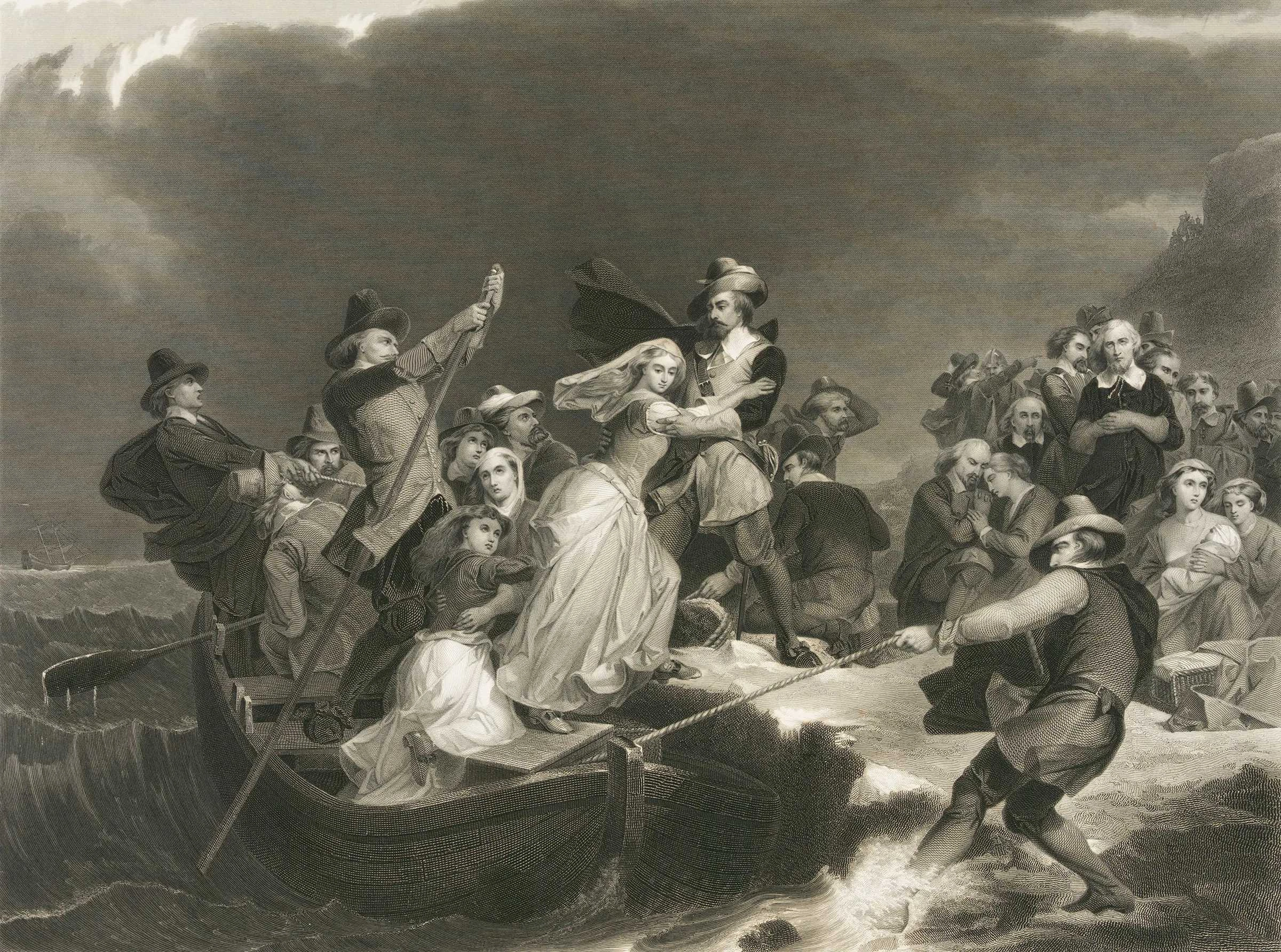
The nine-week voyage of the Puritan ship the Arbella in 1630 is almost as mythologized as the Mayflower landing at Plymouth Rock. The Arbella was the ship on which Massachusetts Bay Colony’s governor John Winthrop would deliver a sermon where he declared America to be a “city on a hill.” Rediscovered by scholars in the 20th-century, Winthrop’s “A Model of Christian Charity,” with its imploration that the colonists must “labor and suffer together, always having before our eyes our commission and community,” has long been interpreted as a foundational text of American identity, a veritable birth certificate for the idea of this as a redeemer nation. Figures on both the right and left, from Ronald Reagan to John F. Kennedy, have long quoted Winthrop, his invocation in the sermon conceived as one of the earliest and most potent expressions of American exceptionality. So much so that the governor is retroactively understood as a kind of de-facto founding father.
Yet alongside the governor was a very different man, his 24-year-old son John Winthrop the Younger, who had in his possession an unusual set of books which he described as a “Hogshead of Ancient papers of Value;” works such as those by the notorious English alchemist, necromancer, and occultist John Dee. Dee—the magician and court-astrologer to Elizabeth I decades before the Arbella sailed—was infamous for his supposed communications with angels in an esoteric tongue called “Enochian.”
That Dee also penned the first instance of the phrase “British Empire” speaks to the ways in which occultism and the project of nation-building have been strangely intertwined, a combination of some interest to Winthrop the Younger. Like his father, the junior Winthrop was a pious Christian. But unlike him, the son was also fascinated by subjects magical. He was as much Shakespeare’s Prospero as he was a Puritan Divine, as much Marlowe’s Dr. Faustus as he was an American founding father.
It’s worth considering Winthrop’s example and the forgotten occult origins of the American experiment, and in particular, how magic has counterintuitively allowed for the imagining of alternate political arrangements, if not for liberation movements.
According to the cultural critic Garry Wills in his 2007 book Head and Heart: American Christianities, our nation has long been defined by two philosophical perspectives that reach their fullest summation when in harmony. “The emphasis of the Enlightened religion is on the head,” argues Wills, while the “emphasis of Evangelicals is on the heart.” For Wills, the head is the purview of the great rationalist projects of the 18-century, of Thomas Jefferson and Benjamin Franklin, while the heart is seen in the various emotional and prophetic Great Awakenings of American history. According to Wills, the most American of figures—from Roger Williams to Ralph Waldo Emerson, Henry David Thoreau to Martin Luther King—are so American in part because they fuse these dichotomies, they marry heart to head.
Yet Winthrop the Younger, and forgotten figures in his stead, fused both head and heart, but in their occult fascinations they also added an additional element no less American: the spirit.
Like his father, Winthrop would have prominent political roles, in his case being the governor of the Connecticut Colony, despite dabbling in the same angelic communications as did Dee, and indeed borrowing the personal occult symbol of that wizard as his own personal cipher, as historian Walter W. Woodward reports. While Connecticut was founded by draconian theocrats, Winthrop helped reform it into a relatively tolerant settlement that banned the execution of witches a generation before the Salem Witch Trials, for as Woodward writes, his esoteric beliefs “became a factor fostering religious toleration.” The governor’s necromantic interests, which he did nothing to hide, were instrumental in his more humane leadership, the study of magic and the esoteric being a basis for Winthrop’s curious, empathetic, and comparatively liberal governance that exemplifies not just the head of Enlightenment and the heart of Evangelicalism, but also the spirit of Occultism. A “cosmopolitan intellectual and world traveler who journeyed through Europe and to the Middle East searching for knowledge of scientific mysteries,” as Woodward describes him, Winthrop was a figure who was involved in the synthesis of empirical science and occult mysticism in the service of “practical reform programs to improve world conditions.”
The partisans of both the Enlightenment and Evangelicalism, with otherwise little in common, might share a blanching at that description of the occult project. But Winthrop wasn’t the only figure in American history to see in occultism the possibility of imagining different ways of being, of human improvement. Author Mitch Horowitz in Occult America: The Secret History of How Mysticism Shaped our Nation writes that rather than “seeing mystical ideas as a means to narcissistic power or moral freedom,” these figures “emphasized an unlikely ethic of social progress and individual betterment… religious radicals, acting outside the folds of traditional churches… [who] transformed a young nation into the launching pad for the revolutions in therapeutic and alternative spirituality.”
During Winthrop’s own century, a figure such as the quasi-pagan colonist Thomas Morton was inspired to racial toleration with indigenous Americans through his own beliefs, while a hundred years later the Public Universal Friend, born Jemima Wilkinson, promulgated a doctrine of radical gender equity born from their occult faith. During the 19th-century, among those members of the denomination known as Spiritualism, which included such prominent leaders as the Free Black man Paschal Beverly Randolph and Cora L.V. Scott, may have believed in spectral contact from beyond the grave while being associated with seances and Ouija Boards, but their faith was also instrumental in liberation movements from abolitionism to women’s rights. During the 20th century, the New Age counter-cultural movement of the 1960s, for all its excesses, was also dedicated to more expansive and revolutionary definitions of what it means to be human, from the “Merry Pranksters” to the Esalen Institute, the Whole Earth Catalogue to Woodstock.
The head and the heart working together may be necessary, but the spirit can’t be forgotten either.
To think magically, to think with the spirit, despite the risks of superstition and irrationalism, also allows for the consideration of something beyond the heart or head. That is to say that occultism is less concerned with faith or facts, but rather with fancy. According to the philosopher Jeffrey J. Kripal in his book How to Think Impossibly: About Souls, Time, Belief, and Everything Else, such ways of understanding “elicits awe, indeed a sense of wonder so great that it often ends up transforming the course of human history.”
Like literature and art at their greatest, considering the occult allows us to experience different ways of being and in turn of different ways of doing. Such a way of defining occult thinking has less to do with the positive content of this or that alchemical hypothesis or magical ritual then it does with the wonder of conjecture, the liberation of the spirit.
During the Renaissance, when occultism enjoyed its golden age, a philosopher such as the Italian Marsilio Ficino, could make the radical claim in 1495 that every individual “possesses the excellence of infinity and eternity,” that we progressively “incline toward the infinite.” Less than three centuries later, Winthrop would exemplify that creed of human improvement; three centuries after Ficino’s idiosyncratic claim, the Declaration of Independence would include the “pursuit of happiness,” of self-fashioning, self-improvement, and individual human progress, as inalienable rights.
Such a contention is, in its own manner, not one of the head or the heart but of the spirit, of that oldest occult commandment that one must “Do what thou wilt.” America, then, was not just a product of rationalist philosophy and passionate religion, but also of iconoclastic figures. Figures, in fact, like Winthrop, who were crucial and more influential than has been supposed in the gestation of this city on a hill, this veritable republic of magic, this Occult States of America.
https://time.com/7157922/america-occult-origins-essay/