@robertbarnes
https://www.timesunion.com/hudsonvalley/news/article/east-fishkill-data-center-plan-sparks-backlash-22270553.php
Yes. I’d combine them into one Albany + East Fishkill AI/Data Center FOIL–FOIA project with a narrow public-interest theory:
The public is seeing “local land-use proposals,” but the real story begins earlier — in grid interconnection, utility-capacity planning, state economic-development contacts, tax-incentive discussions, and large-load policy.
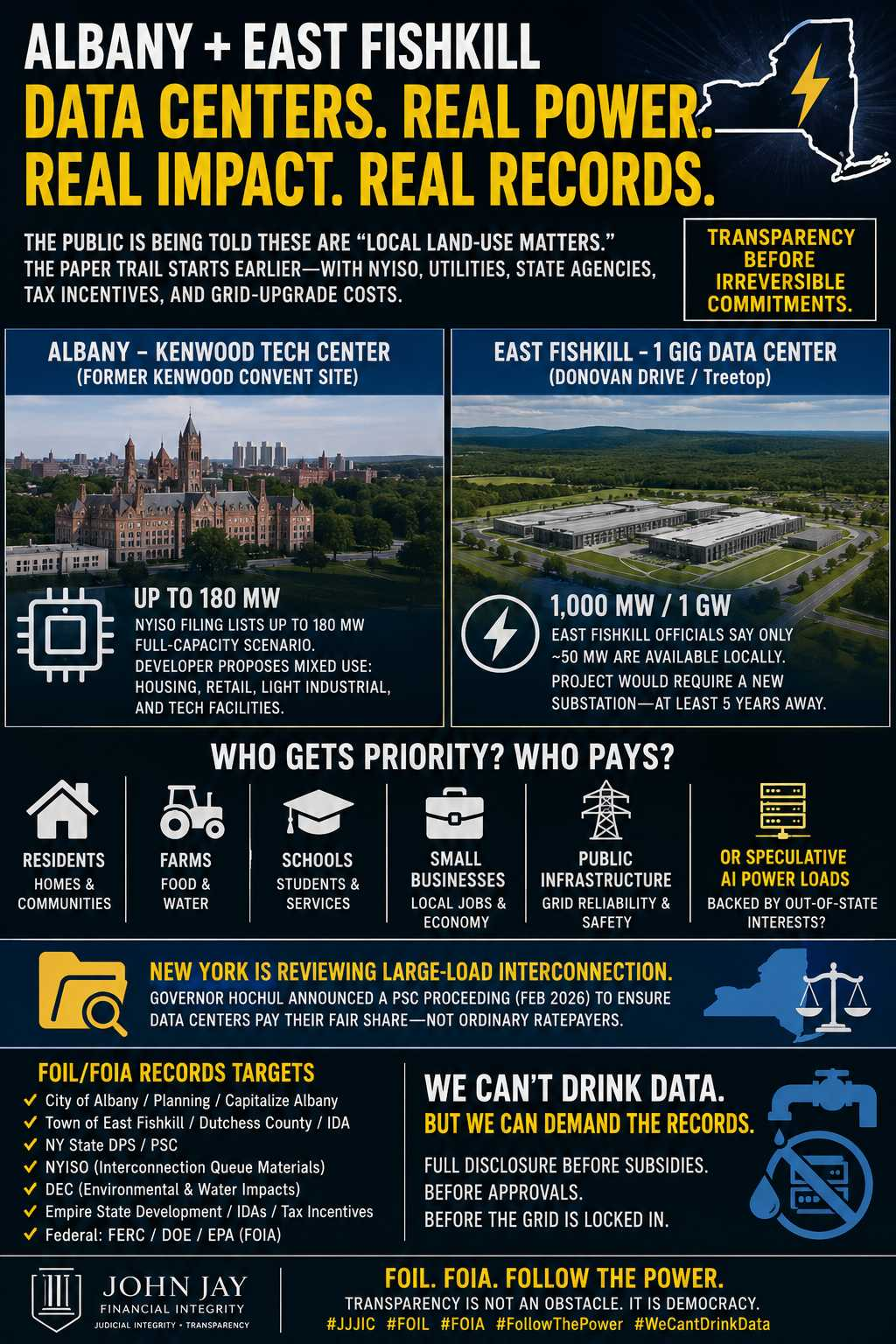
For Albany, the Kenwood proposal reportedly involves a proposed Kenwood Tech Center at the former Kenwood Convent site, with a NYISO filing listing up to 180 MW of power use, though the developer says that is a full-capacity scenario and the project would include mixed uses such as housing, retail, light industrial, and tech facilities. For East Fishkill, the proposal surfaced through the interconnection process as a potential 1,000 MW / 1 GW load, far above the roughly 50 MW local officials say is currently available.
The statewide hook is even stronger because Governor Hochul’s office announced a Public Service Commission proceeding in February 2026 to review large-load interconnection, cost allocation, and tariff structures, specifically emphasizing that data-growth industries should pay the utility-expansion costs they impose rather than shifting them to ordinary ratepayers. NYISO itself has said large-load projects in its queue grew to 29 projects totaling nearly 6,055 MW as of July 2025, and that the increase poses a major reliability challenge.
Working project title
JJJIC / FOIL–FOIA Large Load Data Center Transparency Project: Albany Kenwood + East Fishkill
Core framing
These are not merely zoning controversies. They are early-stage administrative decisions about who controls scarce electric capacity, who pays for grid upgrades, what public subsidies are offered, and whether local communities receive full disclosure before projects become politically or financially entrenched.
Best combined FOIL/FOIA targets
1. City of Albany / Planning / Capitalize Albany
Request records concerning the Kenwood Tech Center, Guild Ventures, EKG Group, the former Kenwood Convent site, data center use, energy demand, fiber access, zoning, SEQRA, public benefits, tax incentives, and communications with NYISO, National Grid, DPS/PSC, NYSERDA, DEC, Empire State Development, Albany County, and private consultants.
2. Town of East Fishkill / Dutchess County / IDA
Request records concerning Treetop, Donovan Drive Holdings, the Donovan Drive warehouse/data-center site, 1 Gig Data Center East Fishkill, industrial moratoria, zoning revisions, energy availability, substation planning, tax incentives, SEQRA, water, noise, emergency services, and communications with NYISO, Central Hudson, Con Edison, DPS/PSC, DEC, ESD, and state legislators.
3. NYS DPS / PSC
This is the key state target. Request records relating to large-load interconnection, Albany Kenwood, East Fishkill, data centers, AI computing, grid upgrade cost allocation, ratepayer impacts, tariff structures, and any communications with NYISO, utilities, local governments, developers, Governor’s office, ESD, NYSERDA, and DEC. The PSC proceeding is the statewide administrative hub.
4. DEC
Water, stormwater, wetlands, emissions from backup generators, battery systems, noise, and SEQRA coordination. The East Fishkill public opposition is already framed around energy burden, environmental risks, and community impacts.
5. Empire State Development / IDAs
Tax breaks and “jobs versus megawatts” are the political weak points. The Times Union reported statewide concern that large data centers may bring major tax benefits while creating relatively few permanent jobs.
6. Federal FOIA angle
FOIA is cleaner at FERC, DOE, and possibly EPA, not NYISO directly. NYISO publishes public queue materials and operates under FERC-regulated tariffs, but it is not the same kind of FOIL agency as a New York town or state department. So the method is: use NYISO public materials as the index, then FOIL/FOIA the agencies around it.
Draft combined records request language
Pursuant to the New York Freedom of Information Law, I request records from January 1, 2024 to the present concerning proposed, contemplated, studied, or discussed data-center, AI-computing, high-intensity computing, “large load,” or “energy-intensive” projects in New York State, including but not limited to the proposed Kenwood Tech Center / former Kenwood Convent site in Albany and the proposed 1 Gig Data Center / Donovan Drive / Treetop-related project in East Fishkill.
This request includes records reflecting communications, studies, memoranda, meeting notes, presentations, applications, draft applications, interconnection discussions, utility-capacity analyses, grid-upgrade cost discussions, ratepayer-impact analyses, tariff or cost-allocation discussions, SEQRA materials, zoning or land-use communications, tax-incentive or PILOT discussions, water or environmental-impact discussions, and public-benefit representations.
Search terms should include: “data center,” “AI,” “artificial intelligence,” “large load,” “high-intensity load,” “energy intensive,” “NYISO,” “interconnection queue,” “Kenwood,” “Kenwood Tech Center,” “Guild Ventures,” “EKG Group,” “former Kenwood Convent,” “East Fishkill,” “Donovan Drive,” “Donovan Drive Holdings,” “Treetop,” “1 Gig Data Center,” “1 GW,” “1000 MW,” “180 MW,” “substation,” “grid upgrade,” “cost allocation,” “ratepayer,” “tariff,” “PILOT,” “IDA,” “SEQRA,” “water,” “backup generator,” and “battery storage.”
Public post version
Albany Kenwood and East Fishkill should be treated as one statewide transparency issue.
The public is being told these are local land-use matters. But the paper trail likely starts earlier — with NYISO queue filings, utility capacity discussions, state economic-development contacts, PSC large-load policy, possible tax incentives, and grid-upgrade cost allocation.
A 180 MW Albany filing and a 1,000 MW East Fishkill proposal are not ordinary development issues. They raise the same administrative question: who gets priority access to New York’s electric capacity, who pays for the upgrades, and when does the public get notice?
FOIL and FOIA should follow the power demand before the zoning application appears. This is administrative transparency before irreversible infrastructure commitments.
This fits well under a John Jay Financial Integrity / Judicial Integrity / FOIL-FOIA transparency umbrella because the clean issue is not “anti-tech.” It is: public records first, subsidies second, approvals last.