@RobertBarnes, @VivaFrei
A Prophetic Warning —
The Deep State’s Tyranny Endures, by David S. D’Amato
"Nowhere in the Constitution does it carve out a spot for secretive bureaucracies that never have to answer to the public."
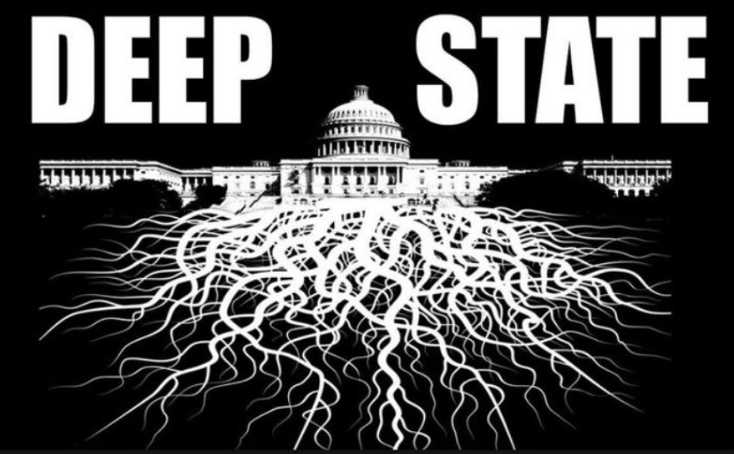
Much ink has been spilled over the past few years on the subject of “the deep state”—what it is, who operates it, where it is located, whether it is secretly working in the background to oust Donald Trump from the White House. It has therefore become important to undertake a more serious treatment of the deep state, one that avoids the pitfalls of the partisan fracas. To attempt a definition, the deep state is that portion of the federal administrative bureaucracy that is unaccountable, secretive and opaque, relatively permanent, and armed with extremely dangerous powers, regularly abused (though we might observe here that such powers themselves are abuses per se).
Of particular importance here are the military, intelligence, and national security components of this apparatus, not only because their activities are the most dangerous and most offensive to the rule of law, but because they are the most secretive and unresponsive to electoral politics. Nominally and formally a part of the executive branch, this bureaucracy is a de facto fourth branch, nowhere contemplated by the Constitution, isolated from any notion of popular sovereignty. It is unaccountable in that it acts with impunity and without meaningful oversight from the people’s representatives in Congress or from the President. There is no one to check it or rein it in. Almost all of its actions are kept secret, privileged and classified as implicating sensitive national security concerns; the deep state is thus completely lacking in transparency, always pointing to the safety and security of American citizens to justify its secrets. Related to its secrecy is its mendacity, its reliance on a systematic program of lies and disinformation designed to hide its actions from the public and the democratic branches of government. So commonplace are the lies of the intelligence and national security establishment that American journalists on the whole no longer even feign surprise or outrage when intelligence bigwigs like James Clapper and Michael Hayden (to give just two prominent examples) brazenly lie to our elected representatives; they are handsomely rewarded for their “service,” uniformly belauded by the Right People with the Right Opinions. This is dangerous to a free society, more dangerous than Trump’s ridiculous brand of Know Nothingism.
The deep state is also characterized by its relative permanence, its personnel remaining in their positions regardless of who occupies the White House. Indeed, the “deep” in “deep state” denotes, perhaps, elements that are abiding or enduring, unchanged by the country’s two and four-year electoral substitutions, a group of permanent power centers underneath, if you will, politics. Finally, it is defined by the kind of absolute power it wields, the power of life and death, its very real license to kill—and to do so outside of the judicial process, beyond the reach of the law (domestic or international) and elected officials. It kills, tortures, imprisons, spies, and conspires in the overthrow of foreign governments all without any requirement that it answer to anyone. We must ask how a supposed liberal democracy reconcile itself to such power.
It is interesting to witness elite Beltway centrists grapple with the deep state as an object of commentary, to see them vacillate between two irreconcilable positions: (A) the deep state does not exist, but is only a ridiculous, though still dangerous, right-wing conspiracy theory concocted by Trump apologists to damage faith in government institutions and legitimate civil service; and (B) something like the deep state certainly exists, but is worthy of praise and admiration as the locus of the knowledge, expertise, and superior judgment of qualified professionals who have nobly chosen to serve their country rather than making lots of money in the private sector. The defenders of this extra-democratic infrastructure, found in the so-called “reasonable center,” appear to be willfully ignorant of its dark history. Last year, in a piece titled “God bless the ‘deep state,’” Washington Post columnist Eugene Robinson gushed, “the deep state stands between us and the abyss.” In order to sincerely believe this, one would have to know virtually nothing about the record of criminality associated with the intelligence agencies and the FBI. Still, however horrifying is the notion “God bless the deep state,” it at least has its transparent embrace of authoritarianism to recommend it; it is, for that reason alone, to be preferred to either the proud ignorance or outright dishonesty of the view that the deep state (whatever we choose to call it—on which more below) simply does not exist. Those among the Beltway literati who acknowledge that it does believe that this kind of power is good and proper insofar as it is exercised by the Right People, by people like them, urbane professionals who hold the Right Opinions, attend the right charity events, and hold the appropriate level of scorn for Donald Trump. To distrust “our expert civil servants” is, for progressives, evidence of a lack of sophistication, a crude populism or anti-elitism that unthinkingly resents achievement and expertise. This sycophantic, near-absolute deference to and respect for the intelligence and national security elite may be the single worst thing to come out of the Trump years, worse even than any of the administration’s own actions.
It is striking that the most knowledgeable and articulate critics of this system of government have no interest in “the Trump circus,” as William M. Arkin called it. Arkin and his like have been focused on a deeper and more serious threat, “the increasing power of the national security community” and “the creeping fascism of homeland security,” subjects in which the news media seem to have no interest whatsoever, particularly since the election of Donald Trump. Upon his election, or perhaps as his campaign became more viable, the character of the conversation around the deep state changed; it took on the appearance of a shallow partisan talking point and a nutty conspiracy theory rather a subject of serious scholarly and journalistic inquiry, which is what it had been for years before Trump entered the political fray.
In his book National Security and Double Government , international law scholar Michael J. Glennon identifies a “Trumanite network” responsible more than anything else for the transfer of power from the Constitution’s three branches of government “to unelected bureaucrats who run the national security apparatus.” He argues that we have moved in the direction of an “autocracy” with less and less democratic accountability. “The watchdogs are asleep at the switch,” he says, speaking of Congress. Congress didn’t know torture black sites existed, for example, among many other crimes and abuses to which they were blind. John Kerry, at the time Secretary of State, remarked that many of the government’s surveillance programs have been “on automatic pilot,” with no one in the civilian government able to stop or control them. And as President Obama said, “The CIA gets what it wants.” It could’ve been said no less accurately of any of the other national security agencies. It must be noted that Glennon takes care to distinguish this Trumanite network from the deep state, pointing out that there was never a conscious or deliberate decision to adopt this system—that the United States rather drifted into it. He contends that to refer to the system of double government he describes in his book as entailing the deep state only confuses matters. For Glennon, the definition of the deep state requires a kind of shadowy conspiracy to commandeer or overthrow legitimate democratic government, a “silent coup, in which a group of nefarious plotters has taken over the government of the United States.” And that, he says, is not how double government has emerged in America. Yet we might take issue with Glennon’s definition of the deep state, for arguably the system of double government, as outlined by Glennon, is just what most commentators who have used the term (whether or not they see it as a danger) have meant by “deep state”; that is, the accepted definition does not seem to require the kind of secret, premeditated plot that Glennon uses to distinguish his term, double government, from the idea of the deep state. Indeed, as Jacob Silverman observes, notwithstanding Glennon’s studious avoidance of the term, “his book National Security and Double Government is essentially a taxonomy of the same [that is, of the deep state].” Further, in his book American Coup , William M. Arkin argues that in fact the American Coup is complete, having created “a dual system” in which “an unelected elite…cares for secret law.”
In a talk earlier this year, Glennon considered the disturbing change that has taken place since the beginning of the Donald Trump era in American politics, amazed that the deep state is now regarded as worthy of praise:
They go directly to the people and suggest, “Hey, we’re the good guys now. You should be supporting us.” So that people like Bill Kristol tweet, “Rather the Deep State than the Trump State.” And you see over and over again: a lot of people who hate Donald Trump embrace the national security bureaucracy on the theory that the enemy of our enemy is our friend. They don’t remember what the Church Committee reported in the 1970s; they don’t remember that the CIA spied on American citizens; they don’t remember that the FBI infiltrated student groups of anti-war protestors, civil rights activists; they don’t remember that the FBI, J. Edgar Hoover, tried to, through blackmail, urge Martin Luther King to commit suicide just before he accepted the Nobel Peace Prize; they don’t remember that the NSA assembled a watch list of American critics of the Pentagon and the intelligence community. … They’ve forgotten all of this.
It is the deep state that spies on millions of Americans, elected officials, and foreign dignitaries. (As the heroic whistleblowing of Edward Snowden and others has revealed, the National Security Agency has conducted warrantless, unconstitutional spying on millions of American citizens.) It is the deep state that imprisons and tortures without judicial process. It is the deep state that manages the U.S. government’s infamous kill list—or, in Doublespeak, “Disposition Matrix”—on which are listed the names of people who could be murdered by drone at any moment, for any or no reason. Even American citizens who haven’t even been charged with a crime might end up killed by a drone. Glenn Greenwald writes similarly, “Empowering the very entities that have produced the most shameful atrocities and systemic deceit over the last six decades is desperation of the worst kind.”
Given legal doctrines like the state secrets privilege, we likely only know about a tiny fraction of the deep state’s crimes; under that privilege, if the government claims that the continuation of a legal case in court may compromise national security interests, the evidence in the case is excluded. Astute observers will notice that such a powerful privilege functions effectively to preclude all legal challenges to the government’s actions. For as long as the government avers that important national security interests could be compromised, a case, which involves the presentation of evidence, is ruled out, rendered impossible. The government thus sits in final judgment of the constitutionality and legality of its own actions, even in—especially in—cases with allegations of the most egregious violations, for example, claims of torture. This kind of power should offend anyone, Democrat or Republican, liberal or conservative, even somewhat interested in safeguarding the rule of law, protecting democracy and the constitutional separation of powers, and promoting government transparency and accountability in general. Powers like the state secrets privilege aren’t partisan issues, and they’re not conspiracy theories cooked up to legitimize the current president, casting him as the target of some shadowy group of intelligence operatives. Indeed, what the state secrets privilege, the NSA spying story, and the U.S. government’s general history of disregarding due process and of engaging in illegal wars and war crimes all tend to show is that positing elaborate conspiracy theories and secret plots is not at all necessary—that is, even when Americans are aware that the U.S. government is violating the rights of citizens and ignoring the Constitution’s most important provisions, they seem to be powerless to change this system, or else simply lack the political will to change it.
Harry Truman, not usually one for second thoughts, remarked to Merle Miller that the establishment of the CIA had been a mistake, that the Agency “got out of hand.” It was “practically the equal of the Pentagon,” and “one Pentagon is one too many.” “[T]hose fellows in the CIA don’t just report on wars and the like, they go out and make their own, and there’s nobody to keep track of what they’re up to.… [I]t’s become a government all of its own and all secret. They don’t have to account to anybody.” These are the words of a former president, the man most responsible for the creation of the CIA—not some radical libertarian, anarchist, or anti-war activist, not a Trump supporter looking to cast suspicion on supposedly innocent, public-spirited civil servants. Arguments about the deep state are not at all new to this moment in American political life; they’ve been around for decades, even if the terminology has changed. To pretend otherwise marks one as historically illiterate, or hopelessly partisan, or both. The bizarre and inexplicable admiration for the deep state among American progressives leaves one with the distinct impression that they do not in fact object to Trump’s reflexive authoritarianism, for their politics and their favorite institutions are themselves authoritarian and undemocratic. They object, more likely, to his branding, his open embrace of bigotry, xenophobia, and white-trash populism, his untutored, uninterested approach to important public policy questions, his clear misogyny and history of sexual harassment and assault, all of which—it goes without saying—is repulsive and detestable. But while the Trump administration will soon be a memory, the unaccountable, undemocratic, and indeed criminal institutions that make up the deep state aren’t going anywhere. Americans of all political persuasions would do well to take note.