@RobertBarnes, @VivaFrei
“The Red Decade” Revisited
During the 1930s Great Depression, the Communist Party of the United States (CPUSA) strategically expanded its influence over American literary, cinematic, and labor institutions. This period, termed “The Red Decade” by contemporary critics like Eugene Lyons, was characterized by an unprecedented alignment of writers, filmmakers, and labor organizers with Marxist ideologies
Key Literary and Cultural Figures
The CPUSA sought to shape American literature through its promotion of “proletarian literature”—art and fiction designed to highlight class struggle and critique capitalism.
V. J. Jerome (Victor Jeremy Jerome): Serving as the chairman of the CPUSA’s Cultural Commission, Jerome was the chief intellectual enforcer of party orthodoxy in arts and letters. As the long-time editor of the theoretical journal The Communist (Political Affairs), he regulated Marxist literary criticism and issued directives on how writers and filmmakers should align their work with Soviet policy.
Mike Gold (Itzhok Isaak Granich): A preeminent writer and editor-in-chief of the leftist magazine New Masses, Gold was the principal advocate for proletarian fiction. His 1930 semi-autobiographical bestseller Jews Without Money popularized the genre, and his regular column in the CPUSA’s daily newspaper, the Daily Worker, targeted bourgeois literature while demanding that art be used as a political weapon.
John Steinbeck: Though Steinbeck focused heavily on agricultural exploitation and the California laboring class in classics like In Dubious Battle (1936) and The Grapes of Wrath (1939). Steinbeck maintained an independent stance, often drawing criticism from party hardliners for prioritizing human suffering over strict Marxist doctrine, despite the party celebrating his depictions of corporate greed. He joined the League of American Writers—a Communist-affiliated organization—in 1935.
Erskine Caldwell: Author of agrarian novels like Tobacco Road (1932) and God’s Little Acre (1933), Caldwell exposed the brutal conditions of the Southern tenant farming system. Like Steinbeck, Caldwell was a fellow traveler associated with the party-backed League of American Writers, rather than a disciplined party operative.
U.S. Communist Party (CPUSA) novelists and prominent leftist writers in the 1930s created a vibrant wave of proletarian literature that focused on the struggles of the working class, labor strikes, and the economic devastation of the Great Depression.
Key Communist Party Novelists & Proletarian Writers
Grace Lumpkin: A dedicated proletarian novelist whose works, such as the Gorky Award-winning To Make My Bread (1932) and A Sign for Cain (1935), explored Southern mill strikes and the rise of class consciousness.
Richard Wright: Joined the CPUSA in Chicago in the 1930s, aligning his powerful realist fiction and essays with the Party before later experiencing a complex and eventual break from the organization.
Jack Conroy: Known for his 1933 autobiographical novel The Disinherited, which depicted the harsh realities of coal mining, railroading, and factory labor during the Depression.
Agnes Smedley: A radical journalist and novelist closely tied to the international revolutionary left, known for her semi-autobiographical novel Daughter of Earth (1929) which deeply influenced 1930s radical writing.
Organizations and Cultural Influence: John Reed Clubs:
Established in the early 1930s as local cultural arms of the CPUSA, these clubs nurtured young revolutionary writers, poets, and artists before being succeeded by broader fronts.
The League of American Writers: Founded in 1935 under CPUSA guidance, this organization brought together actual party members and wider “fellow travelers” (liberal and radical authors alike) to oppose fascism and champion social reform through the Popular Front era until its dissolution in 1943.
Explore The History of Blacks and Reds
https://www.lewrockwell.com/lrc-blog/explore-the-history-of-blacks-and-reds/
During the 1930s, the Communist Party USA (CPUSA) played a major, highly influential role in building the Congress of Industrial Organizations (CIO), though historians debate whether it amounted to outright “domination”.
Strategic Alliance: CIO leader John L. Lewis relied heavily on skilled and experienced CPUSA organizers to unionize mass-production industries.
Staff Presence: Estimates indicate that roughly 25% to 30% of the CIO’s initial core organizers were CPUSA members or close allies.
Militant Leadership: Communists and their allies proved effective at leading high-stakes campaigns, winning union elections, and directing critical actions like sit-down strikes.
Extent of Influence
Key Unions: CPUSA members and sympathizers held significant local, regional, and sometimes national leadership roles within prominent CIO affiliates, such as the United Auto Workers (UAW), United Electrical Workers (UE), and the Steel Workers Organizing Committee.
Popular Front Strategy: During the mid-1930s Popular Front era, the CPUSA prioritized broad anti-fascist and progressive labor unity over strict revolutionary posturing, which allowed them to blend smoothly into mainstream New Deal-era organizing.
Limits of Control: While CPUSA activists exerted strong tactical influence and led specific unions, they did not completely control the top-down apparatus of the broader CIO, which remained under the ultimate political direction of non-communist labor leaders like Lewis and Philip Murray.
The CIO formally expelled its left-led, communist-influenced unions by 1950 during the rising tensions of the early Cold
Union Infiltration and the Battle for Hollywood
During the Popular Front era (1935–1939), the CPUSA shifted from creating separate radical unions to “boring from within” mainstream labor organizations. The most culturally significant target was the growing film industry in Los Angeles.
The Screen Writers Guild (SWG): Founded in 1933, the SWG became a focal point for CPUSA organizing. Core party members, notably screenwriter John Howard Lawson (who served as the guild’s first president), used legitimate labor grievances over creative control and pay to establish a strong communist nucleus within Hollywood.
Cultural Infrastructure: The party organized intellectuals through the John Reed Clubs, later re-forming them into the League of American Writers and the American Artists’ Congress. These front organizations allowed the CPUSA to steer cultural narratives, mobilize opposition to fascism, and subtlety embed progressive or collectivist themes into mainstream studio scripts.
West Coast Labor Strikes and Harry Bridges
The CPUSA found its greatest industrial leverage on the Pacific waterfront by supporting radical rank-and-file workers against conservative union leadership.
The 1934 Waterfront Strike
Led by Australian-born longshoreman Harry Bridges, the 1934 West Coast strike shut down major ports and escalated into the San Francisco General Strike. CPUSA organizers heavily supported the strike through activists on the docks and alternative strike newspapers.
Bridges’ Party Alignment
Bridges consistently denied formal membership in the CPUSA. However, he collaborated closely with Communist organizers, relied on their infrastructure, and strictly hewed to the party line. Following the 1939 Molotov-Ribbentrop Pact, Bridges mirrored the CPUSA stance by abandoning his support for Franklin D. Roosevelt and condemning the Allied war effort as imperialist warmongering.
The Birth of the ILWU
In 1937, Bridges led the Pacific Coast locals to break away from the conservative International Longshoremen’ s Association (ILA). They formed the International Longshore and Warehouse Union (ILWU), aligning with the Congress of Industrial Organizations (CIO).
The legacy of this 1930s radicalism culminated in 1950 when the CIO expelled the ILWU during a national purge of communist-dominated unions, citing Bridges’ continuous alignment with Soviet policy platforms.
https://www.lewrockwell.com/lrc-blog/the-red-decade-revisited/
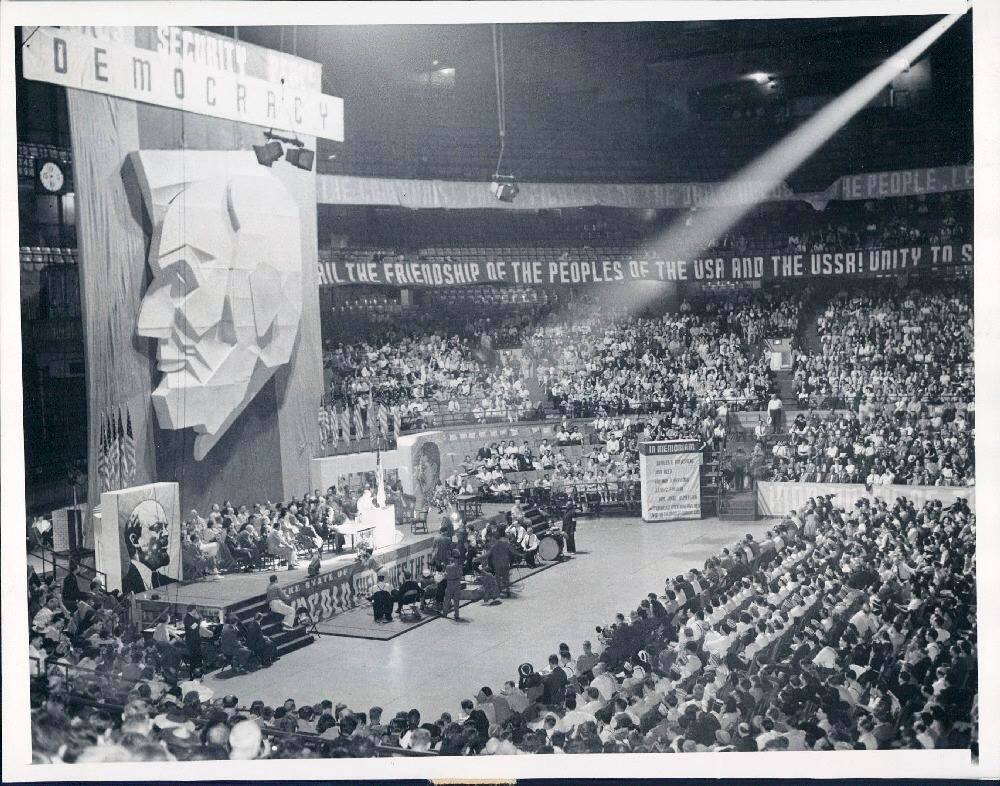
Tenth Communist Party USA convention in Chicago. Portraits of Lincoln, Lenin and Stalin flanked the stage, while the Party’s leader spoke, May 1938.