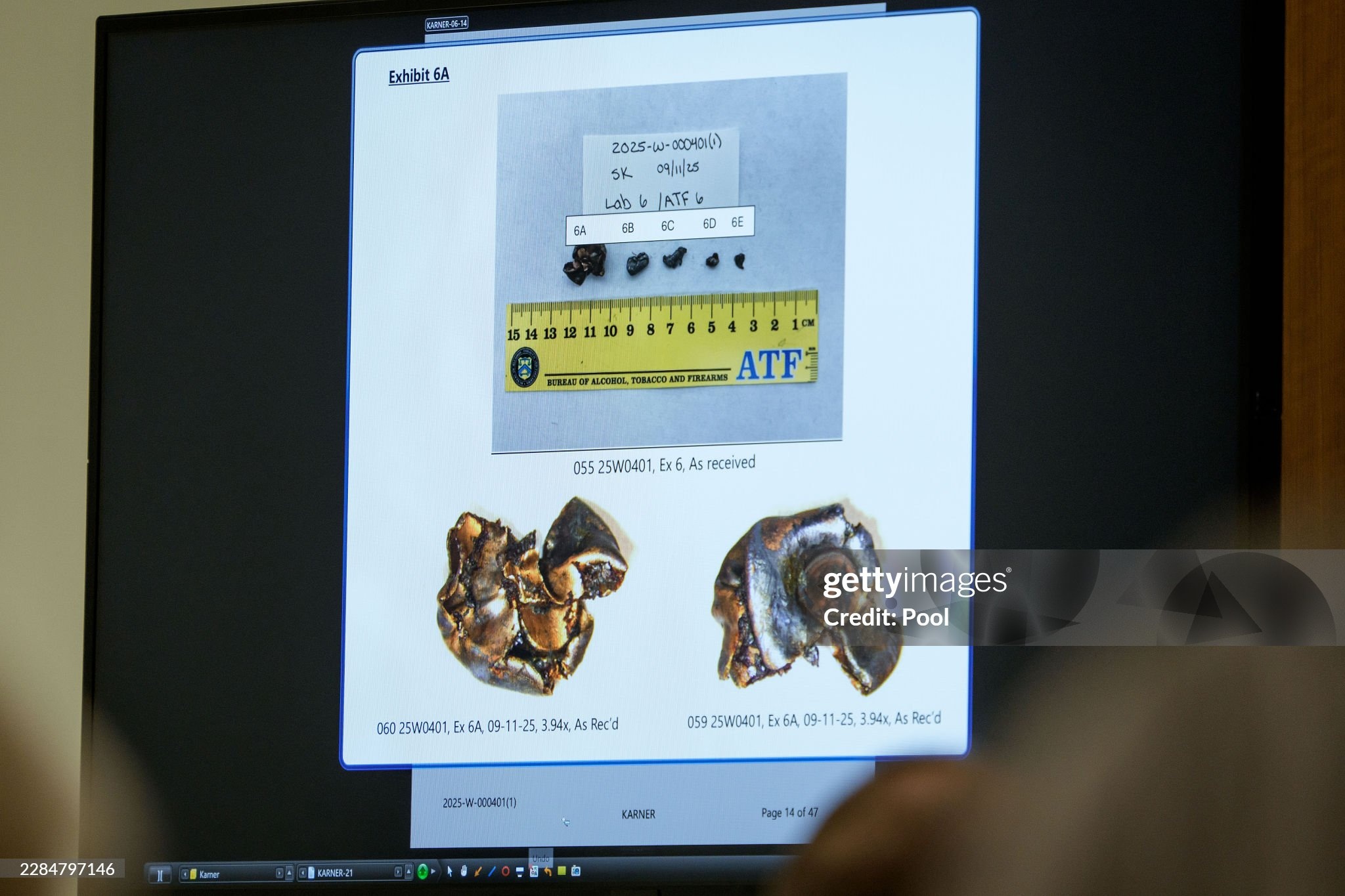
So the alternate theory crowd has proponents that say Charlie Kirk was shot by a 5.56 caliber based on the weight of recovered bullet fragments.
Exhibit 6A Ballistics: The 5.56 theory is geometrically impossible. Math + Hunter logic inside.
Some quick thoughts to head this "it was a 5.56/223" hairball off at the pass before it spins out of control. I keep seeing people try to claim the real assassin used a 5.56 based on some of the online noise, but if you actually look at the Getty images of Exhibit 6A (the crumpled copper jacket fragment shown on the courtroom screens during the July hearing) next to the ATF forensic ruler, the math completely kills that theory.
Here is the boots-on-the-ground reality from a hunter's perspective who has recovered dozens of slugs from deer carcasses over the years.
1. The Surface Area Math Doesn't Lie
Go look at the top overview image of Exhibit 6A. It sits right above the ruler between the 11cm and 13cm marks, meaning even in its crumpled, distorted state, that piece of jacket is almost 2 centimeters wide.
Now do the basic geometry of a standard 5.56/.223 bullet. Unfired, it has a tiny diameter of only 0.224 inches (5.7mm). If you take a brand new 5.56 copper jacket, slice it down the side, and roll it completely flat like a piece of paper, its maximum possible width (circumference) is only around 1.79 centimeters.
Exhibit 6A isn't flat—it's a thick, hollowed-out, deeply folded three-dimensional cup that is STILL measuring nearly 2cm across. You cannot get that much physical metal out of a tiny 5.56 round. There is simply too much "there" there. It is a physical impossibility.
2. Copper Doesn't Stretch Like Silly Putty
I know some online theorists or eventual defense talking heads will try to cope by saying "well the impact just flattened and thinned the copper out so it looks bigger." Anyone who has actually dug bullets out of game knows that's a total load.
When a rifle bullet hits hard material at high velocity, the copper undergoes rapid work-hardening. The metal's crystal structure locks up instantly, making it rigid and brittle, not elastic. It doesn't stretch or thin out seamlessly—it peels backward along the axis to form those classic mushroom "petals" or it fractures into tiny splinters (like the smaller lead pieces 6B-6E in the court tray). For a 5.56 jacket to stretch from a 1.79cm maximum flat layout to a 2cm+ crumpled cup without shattering into dust goes against basic physics and material science.
3. It’s a .30-Caliber Object
The sheer volume of that remaining copper jacket perfectly matches the dimensions of a heavier .30-caliber class projectile (like a .30-06, .308, or even a supersonic .300 Blackout which is flooding the market right now and shares the exact same .308-inch bullet diameter). Even the ATF lab report itself noted the physical fragment diameter measured in the .286 to .301 range and flagged it as a .30-caliber class fragment with 6 right conventional lands and grooves.
Whether you think Tyler took the shot or believe there is a ton of mischief and TPUSA funding games going on behind the scenes, we have to keep our facts straight. The physical evidence locker completely rules out a 5.56 rifle platform.
The geometry alone closes the door on this one.