@robertbarnes
Persian military weaknesses
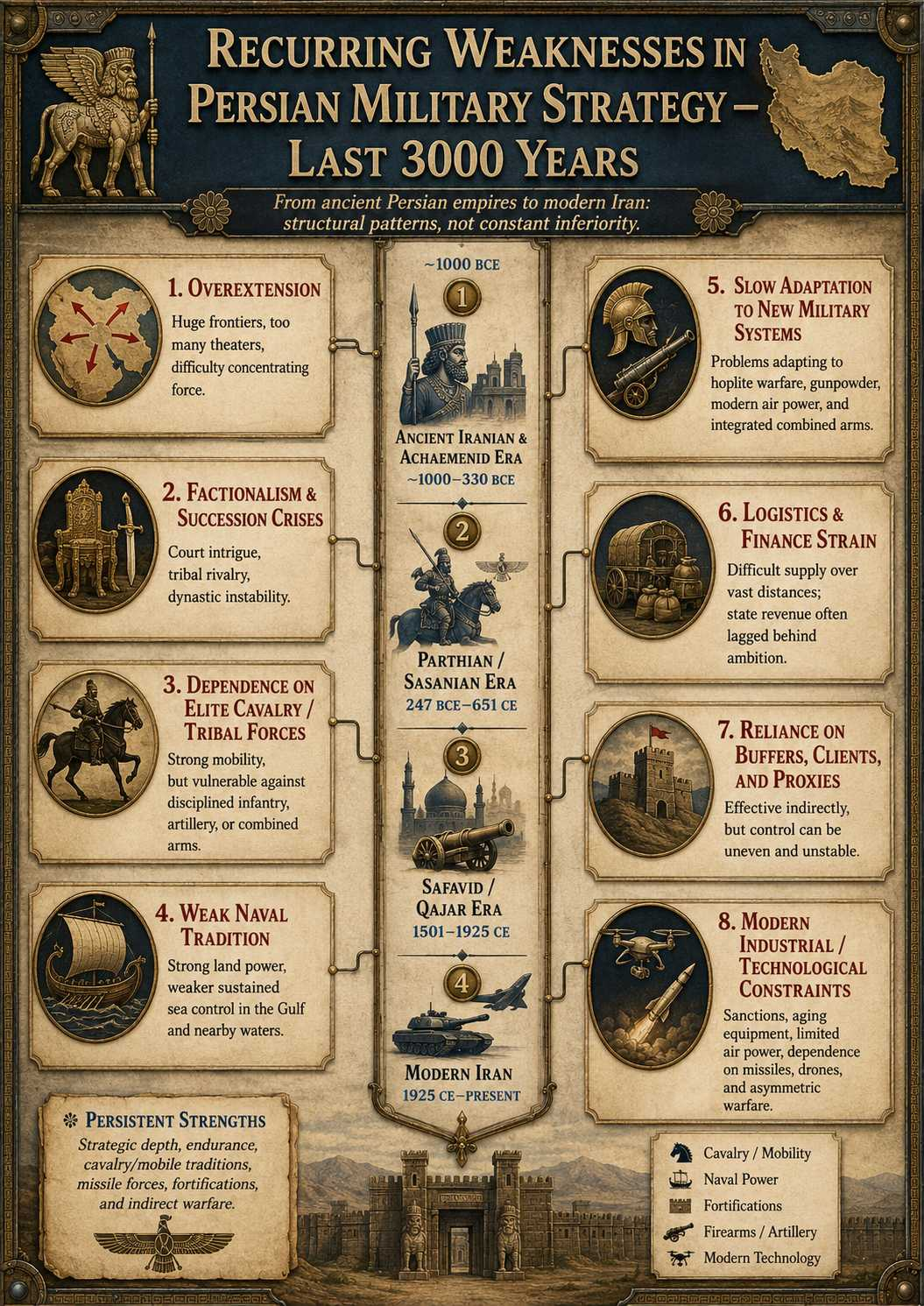
“The pattern is not Persian inferiority; it is imperial overextension, factional succession politics, weak sea control, and delayed adaptation to new military systems. Hormuz today is the modern version: Iran can impose cost and uncertainty, but struggles to guarantee normal maritime control under sustained U.S.-led pressure.”
Going back another thousand years takes us roughly from the Achaemenid / Median world back toward early Iranian tribal warfare, about 1000 BC to 0 AD. The big picture is similar but with a sharper imperial lesson: ancient Persian military strategy was very strong at building empires, absorbing peoples, using cavalry, and governing vast space, but weaker at naval control, heavy infantry shock combat, unified command, siege logistics, and adapting quickly to disciplined Greek/Macedonian combined arms.
1. Too much empire, too many fronts
The Achaemenid Empire was enormous: Anatolia, Egypt, Mesopotamia, Iran, Central Asia, parts of India, and the Levant. That gave Persia wealth and manpower, but also created a strategic weakness. Revolts in Egypt, Greek cities in Asia Minor, steppe threats, and succession conflicts could force the king to fight everywhere at once.
Persian grand strategy often relied on satraps, local elites, tribute, and imperial roads. That was brilliant for administration, but militarily it meant the empire could be slow to concentrate decisive force unless the Great King personally mobilized.
2. Overreliance on levies from many subject peoples
Persian armies were often huge and diverse: Persians, Medes, Egyptians, Babylonians, Phoenicians, Lydians, Bactrians, Indians, Scythians, and Greeks. This gave flexibility, but created uneven quality, language barriers, and command problems.
Against less organized enemies, mass and diversity worked. Against compact, disciplined Greek hoplites or later Macedonian phalanx-cavalry coordination, the Persian army’s variety could become a weakness.
3. Weakness against heavy infantry discipline
This is the classic Greek-Persian lesson. Persian infantry often emphasized archery, mobility, and numbers. Greek hoplites emphasized armor, shields, tight formation, and shock combat.
At Marathon, Plataea, and later against Alexander, Persian forces struggled when forced into close combat against disciplined heavy infantry. Persian cavalry and archers could be excellent, but if terrain or tactics prevented them from breaking the enemy before contact, Persian infantry could be vulnerable.
4. Cavalry superiority did not always translate into decisive victory
Ancient Iranian peoples were superb horsemen. Persian and Median cavalry were major strengths. But the weakness was strategic: cavalry is powerful in open terrain, but less decisive in mountains, narrow coastal plains, fortified cities, and broken Greek terrain.
At Marathon, terrain limited Persian cavalry’s value. In Alexander’s campaigns, Persian cavalry remained dangerous, but Macedonian combined arms used phalanx, Companion cavalry, light troops, and flexible command better.
5. Naval dependence on subject peoples
Persia had a large navy, but much of it came from Phoenicians, Egyptians, Cypriots, and Ionian Greeks, not from a core Persian naval tradition. That created a structural weakness.
At Salamis, Persian naval power was large but not fully coherent. The Greeks exploited narrow waters, local knowledge, and tactical cohesion. Persia could build fleets, but it did not possess the same unified naval culture as its best maritime subjects.
6. The king’s presence created both strength and fragility
The Great King’s personal command could mobilize the empire and inspire loyalty. But it also centralized decision-making. If the king withdrew, died, panicked, or was politically undermined, morale and command could collapse.
This mattered against Alexander. Darius III’s retreats at Issus and Gaugamela became psychologically disastrous. Once the royal center broke, large parts of the imperial army and political structure unraveled.
7. Satrapal autonomy could become military fragmentation
Satraps were useful governors and local military managers. But they could be semi-independent power centers. They had local interests, rivalries, and sometimes private armies.
This made Persia excellent at ruling through local elites, but vulnerable when a fast enemy attacked the imperial nerve centers. Alexander exploited this by defeating royal armies, then absorbing or flipping satrapal networks.
8. Difficulty turning wealth into tactical superiority
Persia was immensely rich. It could hire Greek mercenaries, build fleets, fund diplomacy, and buy allies. But money did not always solve tactical problems.
Greek mercenaries were often among Persia’s best infantry precisely because Persian core forces did not fully match Greek heavy infantry. That exposed a dangerous dependency: Persia could hire the kind of troops it lacked, but those troops were not always politically reliable or strategically sufficient.
9. Diplomacy sometimes substituted for military adaptation
Persian strategy was very sophisticated diplomatically. Persia used subsidies, dynastic politics, divide-and-rule, and bribery to shape Greek politics. During the Peloponnesian War, Persian money helped influence Greek conflicts effectively.
The weakness was that successful diplomacy could delay military reform. Persia often preferred to manage threats indirectly rather than restructure its own army. That worked against divided Greeks, but failed against Macedon once Philip and Alexander unified Greek military energy under one command.
10. Underestimating smaller but more cohesive enemies
Persian imperial thinking sometimes treated Greek city-states or Macedon as peripheral problems. But smaller enemies with high cohesion, disciplined command, and strong military culture could punch above their weight.
The Persian Empire could defeat many local revolts. But against a unified, professionalizing Macedonian war machine, Persian size became less decisive than Persian command speed, tactical integration, and political cohesion.
11. Terrain and logistics punished imperial scale
Huge Persian armies required immense supply. In Greece, narrow roads, mountains, poor local supply, and naval vulnerability made large imperial expeditions difficult. Xerxes’ invasion had enormous logistical ambition, but the Greeks turned geography into a weapon.
Persia was strongest when fighting across open imperial corridors; weaker when forced into constricted, hostile, maritime terrain.
12. Succession and court politics remained a military weakness
Even in the ancient period, Persian military strength depended on royal legitimacy. Court intrigue, succession disputes, eunuchs, nobles, satrapal ambitions, and palace assassinations could weaken strategic focus. By the time of Darius III, the empire had already suffered internal instability, making Alexander’s invasion far more dangerous.
The older pattern is:
Ancient Persian strategy was brilliant at empire management, cavalry warfare, roads, logistics over familiar imperial space, diplomacy, and absorbing peoples. Its recurring weaknesses were naval dependency, uneven infantry quality, overcentralized royal command, satrapal fragmentation, slow adaptation to Greek/Macedonian combined arms, and vulnerability when huge imperial forces were forced into narrow terrain or decisive shock battles.
In one phrase: Persia was often better at ruling space than winning compressed decisive battles against highly disciplined military systems.
Across 2,000 years, “Persian military weakness” is not one thing. Persian/Iranian states often had real strengths: strategic depth, cavalry traditions, missile troops, fortifications, diplomacy, proxy warfare, and the ability to survive invasion. But recurring weaknesses do show up.
1. Strategic overextension
Persian empires often had huge frontiers: Roman/Byzantine west, Central Asian steppe north/east, Arabian/Indian/Ottoman/Russian fronts later. That made it hard to concentrate force. The Sasanian Empire could defeat Rome in one theater, but doing so while holding Caucasus, Mesopotamia, Armenia, and eastern frontiers was exhausting. The same problem recurred under Safavids and Qajars.
2. Dependence on elite cavalry or specialized arms
For much of Persian history, the prestige arm was cavalry: cataphracts, horse archers, tribal cavalry, later Qizilbash cavalry. That could be devastating in open terrain, but it created vulnerability when opponents had superior infantry discipline, siegecraft, firearms, artillery, or naval logistics. Rome/Byzantium, Arabs, Ottomans, Russians, and later Western-trained forces exploited this at different times.
3. Weak naval tradition
Iran is geographically maritime, but Persian power was usually land-centered. Control of the Persian Gulf, Caspian, and Indian Ocean approaches often fell to others: Arabs, Portuguese, British, Russians, and later outside great powers. That mattered because enemies could pressure ports, trade, oil, and chokepoints without needing to conquer the Iranian plateau.
4. Internal factionalism and succession crises
Persian states were often weakened less by battlefield inferiority than by palace politics, dynastic disputes, tribal rivalries, court intrigue, and provincial autonomy. The late Sasanian succession chaos before the Arab conquest is the classic example. Safavid reliance on Qizilbash factions, Qajar provincial weakness, and 20th-century military politicization show variations of the same problem.
5. Difficulty modernizing command and technology
Persian/Iranian states repeatedly faced enemies with better organized military institutions: Roman/Byzantine professional armies, Arab mobilization, Ottoman gunpowder administration, Russian imperial armies, and modern Western militaries. Iran often adapted, but late or unevenly. The Safavid defeat at Chaldiran in 1514 is the famous gunpowder warning: Ottoman artillery and firearms exposed weaknesses in Safavid shock cavalry.
6. Logistics and finance
Iran’s mountains and deserts are excellent for defense, but they also complicate supply. Sustaining large offensive armies outside the plateau was difficult. State revenue systems often lagged behind imperial ambition. When central taxation and logistics failed, rulers leaned on tribal levies, local magnates, or foreign advisers, which reduced coherence.
7. Vulnerability to disciplined infantry and combined arms
Persian forces were often strong in mobility and missile warfare, but weaker when facing armies that combined infantry, artillery, engineering, and logistics well. This is visible against Rome/Byzantium at times, the Ottomans in the gunpowder era, and Russia in the 18th–19th centuries.
8. Reliance on buffers, clients, and proxies
Persian strategy often preferred indirect control: Armenia, Mesopotamia, Caucasus khanates, tribal confederations, later regional proxies. This is rational and often effective. The weakness is that buffers can defect, collapse, invite intervention, or become hard to command. Proxy depth can compensate for conventional weakness, but it cannot always stop a determined state opponent.
9. Air and industrial weakness in the modern era
In the 20th and 21st centuries, Iran’s main military weakness has been industrial and technological constraint under sanctions: aging aircraft, limited air-defense depth compared with top-tier powers, difficulty replacing advanced platforms, and dependence on missiles, drones, mines, small boats, cyber, and proxies as asymmetric substitutes.
10. “Fortress Iran” can become a trap
Iran’s geography makes it hard to conquer. But the same defensive depth can encourage a strategy of endurance rather than decisive conventional victory. Historically, Persian/Iranian forces often survived and imposed costs, but struggled to project sustained power beyond natural defensive zones when facing peer or superior military systems.
The pattern is: Persian military power has often been excellent at survival, attrition, frontier defense, cavalry/mobile warfare, and indirect pressure — but weaker at sustained expeditionary logistics, naval control, rapid institutional modernization, and unified command during political crisis.