


I. INTRODUCTION
Only for Supporters
To read the rest of this article and access other paid content, you must be a supporter


https://www.timesunion.com/capitol/article/new-york-ai-newsroom-bill-21329093.php
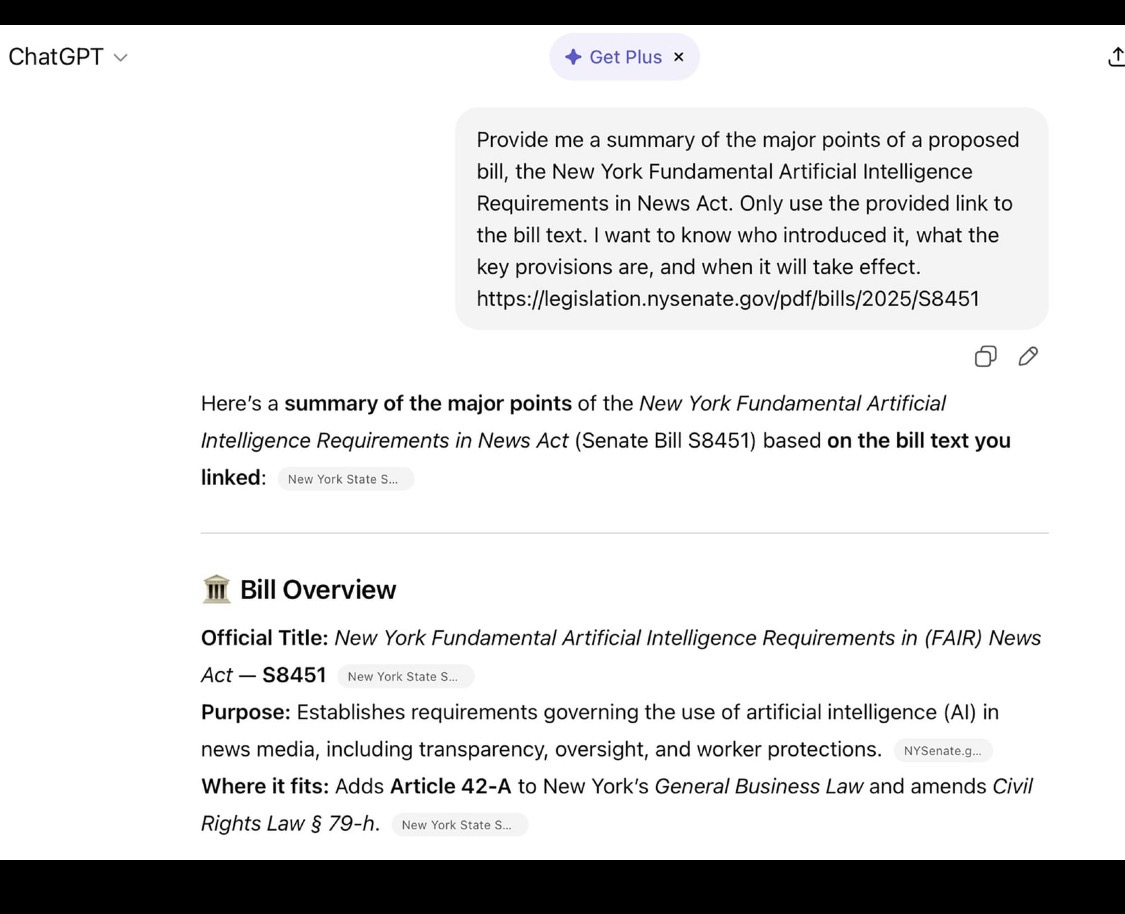
🗞️ What the proposed New York law would do
• New York lawmakers introduced the New York Fundamental Artificial Intelligence Requirements in News Act (NY FAIR News Act). It would require news organizations to disclose when AI is used in creating content, mandate human editorial oversight before publication, and limit how employee work can be used to train AI without notification. 
• Supporters — including journalism unions like the Writers Guild of America East and the NewsGuild of New York — argue this boosts transparency, protects worker rights, and preserves journalistic integrity. 
• A related report notes that many news outlets already use AI frequently without clear disclosure, fueling calls for clearer rules. 
⚠️ Experts’ main concerns
Press freedom risks:
• First Amendment experts warn that forcing regulation of newsroom practices could amount to government intrusion into editorial decisions, potentially chilling independent journalistic judgment. 
Implementation challenges:
• Critics also point out that rigid legal requirements may not keep pace with how fast AI technology evolves, making laws quickly outdated or misapplied. 
Public trust tradeoffs:
• Some research suggests that simply disclosing AI use doesn’t necessarily increase reader trust and may sometimes reduce it — complicating the purpose of such mandates. 
📰 Broader context
• This proposal is part of a larger wave of state-level AI regulation efforts, including laws on AI transparency in advertising passed in New York at the end of 2025. 
• There is also debate at the federal level about how best to regulate AI broadly so individual states don’t create conflicting regimes.
🧩 Why independence concerns matter
Journalists and legal scholars argue that newsroom editorial decisions have historically been protected from government regulation to maintain a free and independent press. Direct regulatory oversight — even with transparent goals — could blur that line, potentially giving officials leverage over how news is produced or what counts as acceptable journalism.
If you’d like, I can go deeper into how similar laws in other states are approaching AI in media, or the specific First Amendment arguments legal experts are raising.z
I did a quick hit on Richard Syrette yesterday. Gotta keep Canadians apprised of the U.S. madness.
We are on our way home!
We might have to call him rigatoni, so it can be Tony for sure! Lol

I. INTRODUCTION
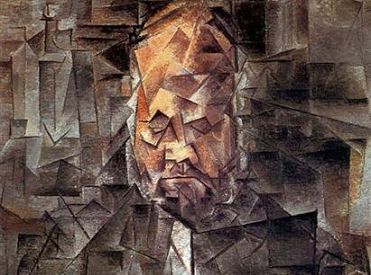
A. Art of the Week
B. Recommendation of the Week
C. Wisdom of the Week
D. Appearances
II. THE EVIDENCE
A. Barnes Library: Curated Weekly Articles of Interest
*Bonus: Bald eagle rescued. https://abc7ny.com/post/nypd-officers-describe-rare-rescue-trapped-american-bald-eagle-icy-hudson-river-nyc/18616678/
B. Best of the Board: Five Fantastic Posts of the Week
*Bonus: Bondi mockery. https://vivabarneslaw.locals.com/post/7703469/spotted-all-over-washington-dc-while-i-normally-don-t-share-the-political-views-of-people-in-dc
**Bonus: Weekly Wisdom. https://vivabarneslaw.locals.com/post/7704649/the-intersection-of-politics-youtube-commentary-and-critical-traffic-infrastructure-https-you
C. Homework: Cases of the Week for Sunday
*Lobbyist disclosure laws. https://www.law.cornell.edu/uscode/text/2/chapter-26
**Lobbying disclosure guidelines. https://www.senate.gov/legislative/resources/pdf/S1guidance.pdf
***Transanity in Canada. https://vivabarneslaw.locals.com/post/7704549/tribunal-ruling-out-of-british-columbia-canada
III. CLOSING ARGUMENT: Constitution Masterclass Series — Article I, Tariffs
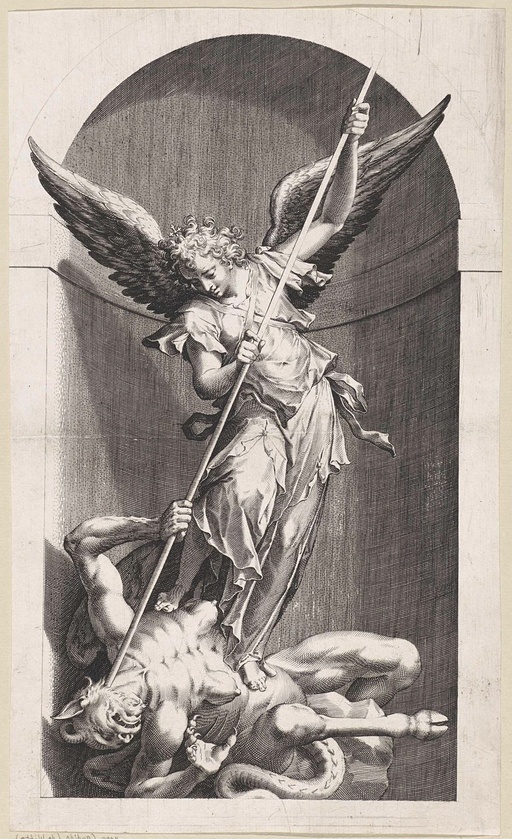
I. INTRODUCTION
A. Art of the Week
B. Recommendation of the Week
C. Wisdom of the Week
D. Appearances

II. THE EVIDENCE
A reminder: links are NOT endorsements of the authors or their interpretation of events, but intended to expand our library of understanding as well as expose ideas of distinct perspective to our own.
A. Barnes Library: Ten of the Top Curated Weekly Articles
B. Homework: Cases of the Week for Sunday
*Bonus: Livenation Ticketmaster Antitrust https://www.hollywoodreporter.com/music/music-industry-news/live-nation-doj-lawsuit-after-gail-slater-resignation-1236504011/
**Bonus: NCAAF eligibility suit. https://www.knoxnews.com/picture-gallery/sports/college/university-of-tennessee/football/2026/02/13/joey-aguilar-eligibility-hearing-tennessee-vs-ncaa/88659399007/
***Bonus: AI plagiarism win. https://www.newsday.com/long-island/education/adelphi-university-ai-plagiarism-lawsuit-oh07enyz
C. Best of the Board: Ten of the Top Posts
III. CLOSING ARGUMENT: Constitution Masterclass Series — Article I, Elections